Introduction
AutoLinkRush presents itself as a shortcut through one of the hardest parts of SEO: link building. The homepage promises instant backlinks, minimal effort, and results delivered in seconds. For anyone struggling to earn links organically, that pitch is difficult to ignore.
But backlink volume has never been the same thing as backlink value.
This article takes a close, evidence-based look at AutoLinkRush using only what is visible on its public-facing pages. Instead of speculating about intent, the analysis focuses on structure, transparency, credibility signals, and the real-world SEO risks tied to automated backlink services.
What AutoLinkRush Claims to Offer
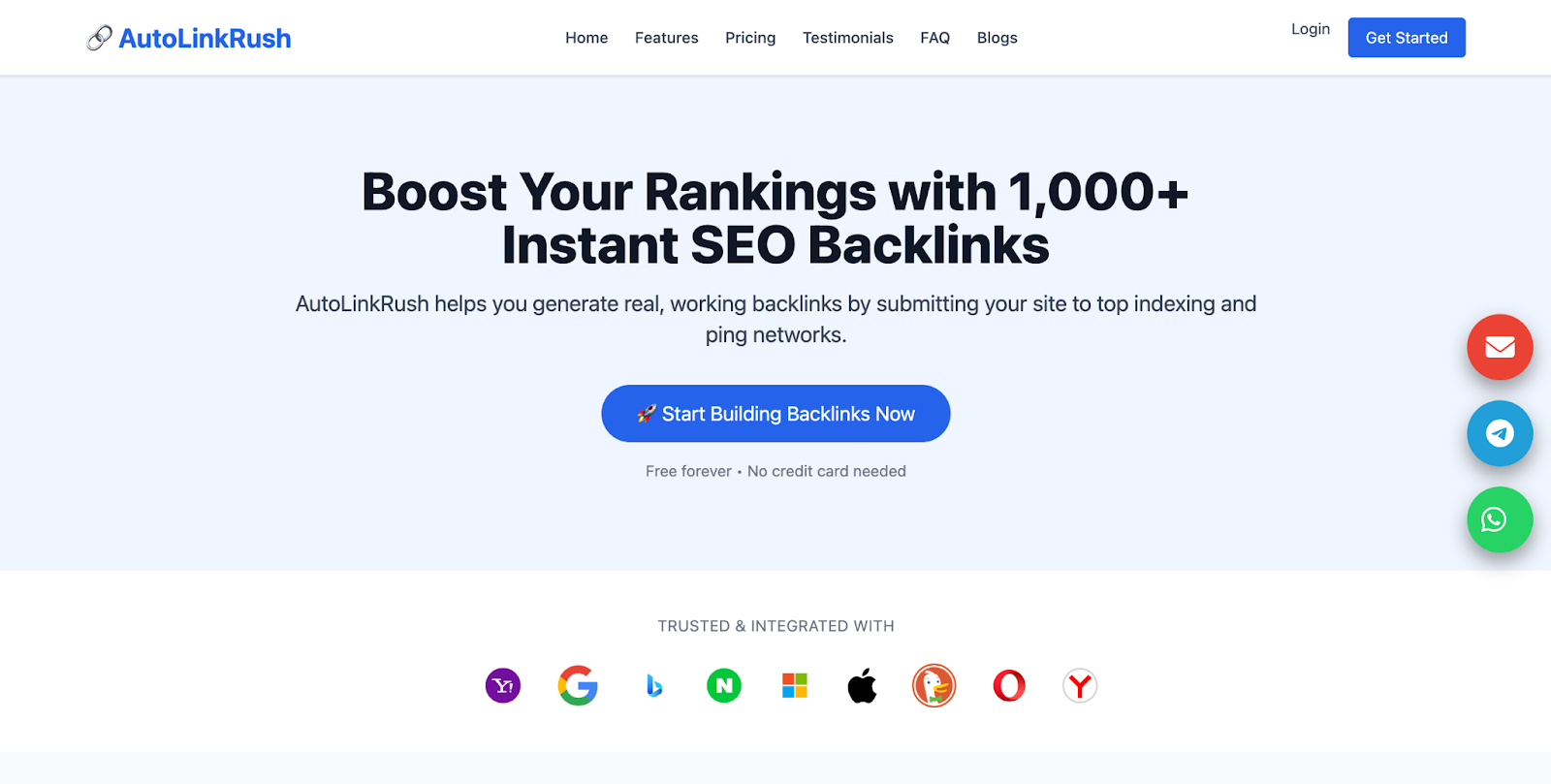
AutoLinkRush markets itself as an instant backlink generator that submits your website to more than 1,000 “trusted sources.” The positioning is built almost entirely around speed and volume.
According to the homepage, users can expect:
● Hundreds or thousands of backlinks generated in seconds
● No software installation
● No credit card required for the free tier
● A simple three-step process requiring only a URL and keyword
Pricing is structured as one-time payments rather than subscriptions, with a free plan capped at 500 backlinks and paid plans scaling up to 10,000 links.
The emphasis is clear. Speed, volume, and ease are the product.
What is noticeably absent is any explanation of where these backlinks come from, how they are placed, or why search engines would treat them as meaningful.
Site Structure and First Impressions
AutoLinkRush uses a single-page landing layout optimized for quick conversions.
The structure follows a predictable funnel:
1. A hero section with bold promises and a call to action
2. A feature list emphasizing automation and scale
3. A simplified “how it works” explanation
4. Pricing tables with low entry costs
5. Testimonials and activity counters meant to build urgency
At a surface level, the design is clean and functional. However, several elements undermine trust on closer inspection.
The live counters that supposedly show active users and total backlinks generated display zeros. This strongly suggests placeholder elements rather than real-time data.
The contact email provided is a generic Gmail address rather than a domain-based email. For a service selling SEO tools, this is a weak credibility signal.
The footer contains garbled text and unrelated gambling keywords, including foreign-language terms that have no connection to backlink services. This is one of the strongest indicators that the site is using a reused template or a repurposed domain.
Credibility and Trust Signals
A fair evaluation requires separating what exists from what is missing.
What Is Present
● Clear pricing with one-time payments
● A phone number and email address
● Social media icons
What Is Missing or Weak
● No company registration details
● No named team members or founders
● No verifiable case studies
● No refund or usage policies visible on the homepage
● Testimonials without surnames, companies, or links
The combination of generic testimonials, placeholder counters, and inconsistent footer content significantly weakens trust. None of these issues alone prove wrongdoing, but together they paint a picture of a site optimized for conversion rather than accountability.
Signs of Domain Repurposing or Template Reuse
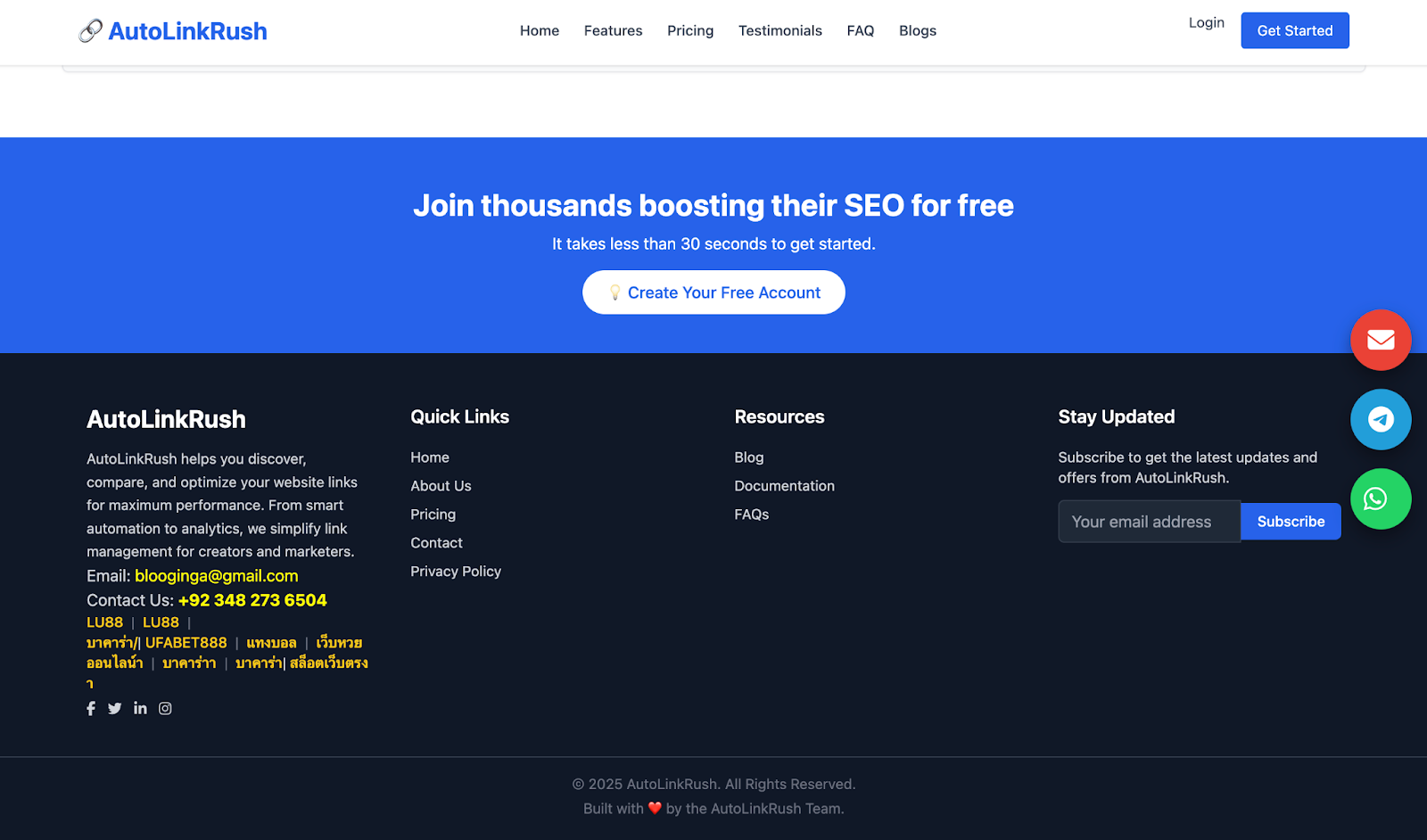
The footer is the most revealing part of the site.
The presence of gambling-related keywords and unrelated language fragments suggests leftover metadata from a different project. This is common in low-effort SEO sites that recycle templates across multiple domains.
In addition, the mismatch between branding, footer content, and contact details raises questions about whether AutoLinkRush is a standalone product or part of a larger network of short-lived SEO tools.
While this cannot be confirmed without historical data, the visible signals strongly support the possibility of domain or template reuse.
How Bulk Backlink Services Typically Work
Understanding the risk requires understanding the mechanism.
Most instant backlink tools rely on automated submissions to:
● Ping services
● Low-quality directories
● Thin web pages with no editorial oversight
These links are created at scale with no contextual relevance and no human review. Search engines have spent over a decade detecting and devaluing exactly this type of behavior.
The result is predictable.
Large backlink counts may appear impressive in reports, but search engines evaluate quality, context, and intent, not raw numbers.
SEO Risks Associated With AutoLinkRush
Using bulk automated backlinks carries real consequences.
The most significant risks include:
● Algorithmic devaluation, where links are simply ignored
● Manual penalties for participating in link schemes
● Long-term reputation damage to the domain
● Wasted crawl budget and indexation issues
Once a domain is associated with spammy backlinks, recovery can be slow and expensive. Disavowing thousands of automated links is not trivial, especially when the source domains are opaque.
For money sites, client projects, or long-term brands, the risk far outweighs any short-term gain.
Business Model and Monetization Signals

AutoLinkRush appears to rely on a high-volume, low-cost model.
The free tier likely serves as lead capture. Paid tiers monetize users who want higher backlink counts. The unrelated gambling keywords in the footer suggest additional monetization streams or shared infrastructure with affiliate-focused sites.
This structure is not designed for long-term customer relationships. It is designed for fast conversions and churn.
Who Should Be Cautious
AutoLinkRush is particularly risky for:
● Businesses investing in long-term SEO
● Client-facing agencies
● Sites in regulated or competitive industries
● Domains with existing authority to protect
Testing such tools on disposable or experimental domains may satisfy curiosity, but applying them to serious projects is not advisable.
Final Verdict
AutoLinkRush offers exactly what it advertises: volume without context.
The homepage reveals multiple red flags, including placeholder engagement metrics, weak transparency, inconsistent site elements, and a product built around automated backlink generation. Modern search engines are explicitly designed to neutralize this approach.
For users seeking sustainable SEO growth, AutoLinkRush is not a shortcut. It is a risk multiplier.
Caution is not optional here. It is necessary.
Post Comment
Be the first to post comment!