
Too Scared to Argue? A 56-Year-Old in Guangzhou Will Do It for $26
If confrontation makes your stomach turn, a man in southern China has a proposition. Pay him ¥188, roughly $26 by the vi...
Elon Musk said on Sunday, October 25, 2026, that SpaceX had closed $40 billion in debt financing to buy graphics processing units, the specialized chips (GPUs) that train and run artificial intelligence models. He announced the SpaceX $40 billion debt deal in a post on X, presenting it as evidence of how much capital is now needed to build AI computing capacity. The money is meant to pay for chips rather than rockets or satellites, and it arrives as investors grow wary of how heavily technology companies are borrowing to fund the AI buildout.
Reuters, which reported earlier in October that SpaceX was in talks to raise the sum, noted that it was not immediately clear what Musk meant by the deal being "closed" or whether investors had agreed to pricing. SpaceX has not issued a separate statement, so for now the announcement rests on Musk's own words.

In his post, Musk attributed the raise to SpaceX's investment-grade status and the cash it earns from Starlink satellite internet and rocket launches. In a follow-up reply, he added that this is primarily callable debt for GPU purchases that will arrive in Q1 and Q2, and not a major factor in the current quarter. Callable debt is borrowing that the issuer can repay early, before its stated maturity, which means SpaceX can repay it ahead of schedule if conditions change.
Several outlets reported that the chips are expected to arrive in the first half of 2027. Notably, Musk did not name the lenders, the interest rate, the maturity or the date the deal closed, and SpaceX has not issued a separate announcement of its own.
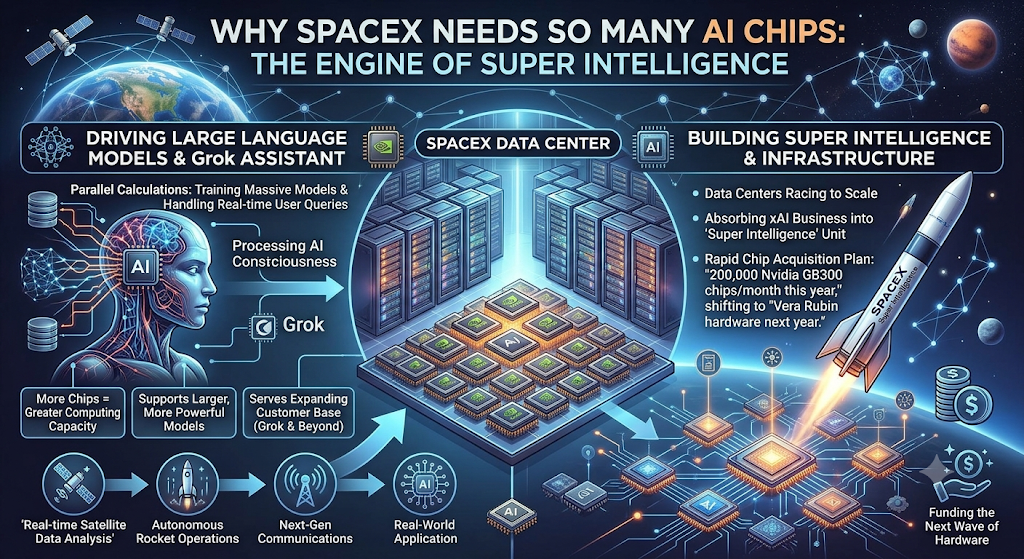
GPUs are the engine of modern AI. They perform the parallel calculations needed to train large models and to answer user queries once those models run, and they fill the data centers that AI companies are racing to build. More chips mean more computing capacity, which supports larger models and more customers.
SpaceX channels this work through its AI unit, now called Super Intelligence, which was built around the xAI business it absorbed and products such as the Grok assistant. On its October 20 earnings call, Musk said the company is tracking to bring roughly 200,000 Nvidia GB300 chips online every month for the rest of the year, with next year shifting mostly to Nvidia's Vera Rubin hardware. The new financing is aimed at paying for that next wave of hardware.
Musk's central argument was that SpaceX could borrow this much precisely because it is not a pure AI company. Alongside Super Intelligence, it runs Starlink and a launch business that flies more orbital missions than any other provider. Those operations generate revenue that does not depend on selling AI data-center capacity.
That distinction matters to lenders. A borrower with diversified cash flow and an investment-grade credit rating, which signals low default risk and lets pension funds and insurance companies hold the bonds, is viewed differently from a company whose income rests almost entirely on AI data centers. Musk said debt markets had, over recent weeks, almost entirely shut off access to money for any company that does not have substantial revenue independent of AI data centers.
The financing follows a strong quarter. SpaceX's revenue climbed 161% from a year earlier to $14.58 billion for the three months ended September 30, and the company swung from a net loss a year earlier to about $4.4 billion in net income. Adjusted EBITDA reached roughly $8.8 billion.
The AI business is now the largest. The Super Intelligence segment generated about $7.56 billion, roughly 52% of quarterly revenue, up around 830% year over year. The Starlink-led Connectivity segment brought in $5.25 billion, the launch business generated $1.77 billion, and Starlink's subscriber count rose to 13.6 million.
These figures also show why SpaceX keeps borrowing. Capital expenditure, the money spent on long-lived assets such as chips and data centers, reached $19.59 billion in the third quarter, more than quarterly revenue, with about $16.4 billion of that going to AI infrastructure. For the fourth quarter, Chief Financial Officer Bret Johnsen said the company expects $35 billion to $40 billion in capital expenditure.
It is worth not confusing these numbers. The $40 billion debt deal is a financing arrangement, separate from the quarterly capital expenditure figure and from total revenue, even though all three sit in a similar range.
Reuters reported earlier this month that SpaceX was in talks to raise $40 billion for the purchase of Nvidia AI chips. Nvidia controls more than 80% of the market for GPUs used in training and deploying AI models, so an order of this size would make SpaceX one of its most significant customers. Under the arrangement described in earlier reporting, SpaceX would take on the debt to fund the purchase, while Nvidia would record the chip order as revenue when it ships.
The deal is a marker of how expensive the competition for computing hardware has become. Securing a large, reliable supply of advanced chips is now a strategic advantage, and the scale of the borrowing underscores that only a handful of players can finance purchases this big. This report makes no claim about any movement in Nvidia's share price or earnings as a result of the deal, because that connection has not been established.
Musk paired the announcement with a blunt forecast about neoclouds. Neoclouds are companies that rent out AI computing power and focus mainly on technology customers, rather than the broad range of services offered by large cloud providers. Nebius and CoreWeave are among the best-known examples, offering capacity tailored for AI.
Because these firms rely heavily on borrowed money, tightening credit hits them hardest. Musk predicted that neocloud companies would face significant consolidation and failures, and later said SpaceX would not buy any neoclouds, calling it "pointless". Investors have already started betting against US neocloud and data-center companies, after fears that their debt-fueled buildout was becoming unsustainable sparked a selloff. Separately, Standard Chartered expects the debt-funded share of AI capital spending to rise to 40% in 2027 from about 25%. Musk's forecast is his own assessment, not a confirmed prediction of future bankruptcies.
Much about the structure is still unconfirmed. Musk did not disclose the lenders, pricing or maturity, and SpaceX has not published terms. Reuters cautioned that it was unclear what "closed" meant in practice.
Earlier reporting sketched a possible shape. Bloomberg reported that the proposed financing would use a special purpose vehicle to keep the debt off SpaceX's balance sheet and preserve its investment-grade credit ratings, with Goldman Sachs leading talks with investors including Apollo Global Management. A special purpose vehicle is a separate legal entity set up to hold specific assets or debt. Other accounts described a package of roughly $10 billion in bank loans and $30 billion in investment-grade debt, with preliminary talks reported between October 6 and 7, 2026, and the GPUs potentially serving as collateral. Those details were reported before Musk's post and have not been confirmed as the final structure. Days earlier, Bloomberg reported that the proposed deal had hit obstacles amid credit-market volatility and rising borrowing costs, which leaves the distance between the proposed terms and a closed deal an open question.
The clearest tests will come in 2027, when the chips Musk described are due to arrive and be installed. Readers should watch whether SpaceX or its lenders disclose formal terms, whether the financing is confirmed to run through a special purpose vehicle, and how much of the $40 billion is actually drawn. Securing financing, drawing the funds, taking delivery of the hardware, and deploying it are distinct steps, and only the first has reportedly happened.
Beyond that, investors will track SpaceX's fourth-quarter capital expenditure against the $35 billion to $40 billion guidance, the continued growth of its AI revenue, and any sign that the predicted neocloud shakeout is taking shape. For now, the SpaceX $40 billion debt deal stands as one of the largest single financings aimed at AI hardware, and a signal of how far the cost of competing in AI infrastructure has climbed.

If confrontation makes your stomach turn, a man in southern China has a proposition. Pay him ¥188, roughly $26 by the vi...

A 49-year-old bricklayer sold almost everything he owned and spent more than 36 hours on a bus, convinced he was travell...

Tom Brady and Candice Swanepoel are reportedly dating, according to a wave of entertainment reporting that began on Satu...

Keeping track of your crypto portfolio is tough, even for the expert. You could make use of a crypto portfolio manager a...