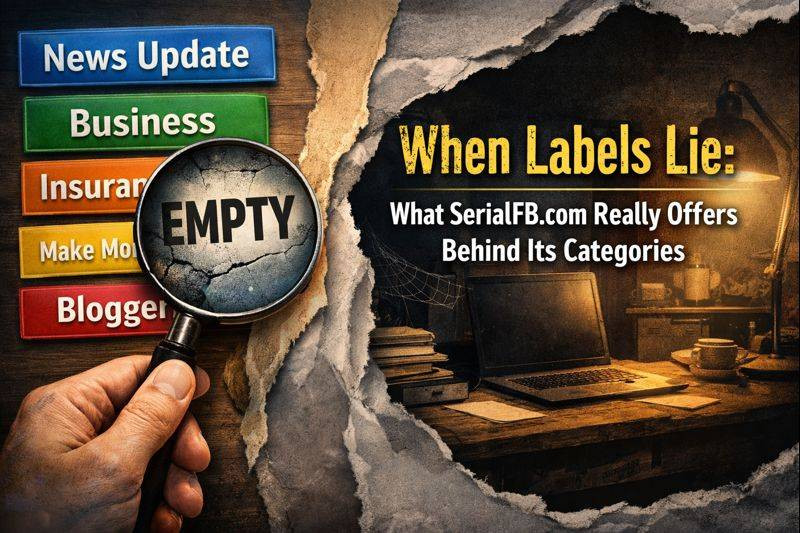
The Premise
GoMyFinance.com markets itself as a financial wellness platform offering free access to credit scores, budgeting tools, and investment insights. On the surface, it sounds like another Credit Karma–style utility. Check your credit, get tips, and improve your finances.
Scratch deeper, and the structure begins to collapse. What appears to be a legitimate personal finance hub is, in reality, an SEO-driven article network built to impersonate credible finance tools.
Its credit score “dashboard” is a claim with no operational backend, and its website behaves more like a traffic funnel than a functioning credit platform.
How the Site Presents Itself

The homepage lists polished categories: Personal Finance, For Investors, Calculators & Tools. Every section hosts endless “guides,” all written by one author — Joseph Campbell — with identical timestamps, imagery, and formatting.
That repetition alone signals automation. There are no genuine credit tools, no live dashboards, and no user portals. When you click through the supposed “Calculators & Tools” tab, you find nothing but generic SEO articles about “Best Auto Loan Calculators” and “Financial Calculators 101.”
The deeper you go, the more obvious it becomes that this site is content-first, product-last.
The Credit Score Claim
GoMyFinance.com’s credit feature claims integration with TransUnion and Equifax, offering users “real-time alerts” and “AI-based score improvement.”
None of those features exist on the live site.
There is no login section, no secure data input, and no user authentication beyond email forms. The “AI-powered dashboard” mentioned in multiple posts is a fictional construct lifted from competing credit platforms.
When you cross-reference their credit content with trusted sources like Credit Karma, Experian, or CRED, GoMyFinance fails every legitimacy test:
● No SSL-secured login for sensitive data
● No integration with bureau APIs
● No identifiable compliance or regulation disclosure
Their “credit score” articles reuse the same explanations you can find on generic financial blogs — often word-for-word, showing signs of scraping or paraphrasing.
Red Flags in Presentation

There’s a particular texture to fake finance websites, and GoMyFinance hits every note:
► Stock photography overload — people holding credit cards, calculators, and jars of coins dominate every header.
► Overused author name — Joseph Campbell appears on every single article, regardless of topic.
► Missing technical depth — articles mention “credit utilization ratio” and “FICO weights” but never cite data sources.
► Excessive publishing uniformity — most posts are dated within a few days of each other, suggesting automated scheduling, not editorial curation.
This isn’t a content brand. It’s a synthetic site pretending to be one.
A Look at Their “About Us” Page
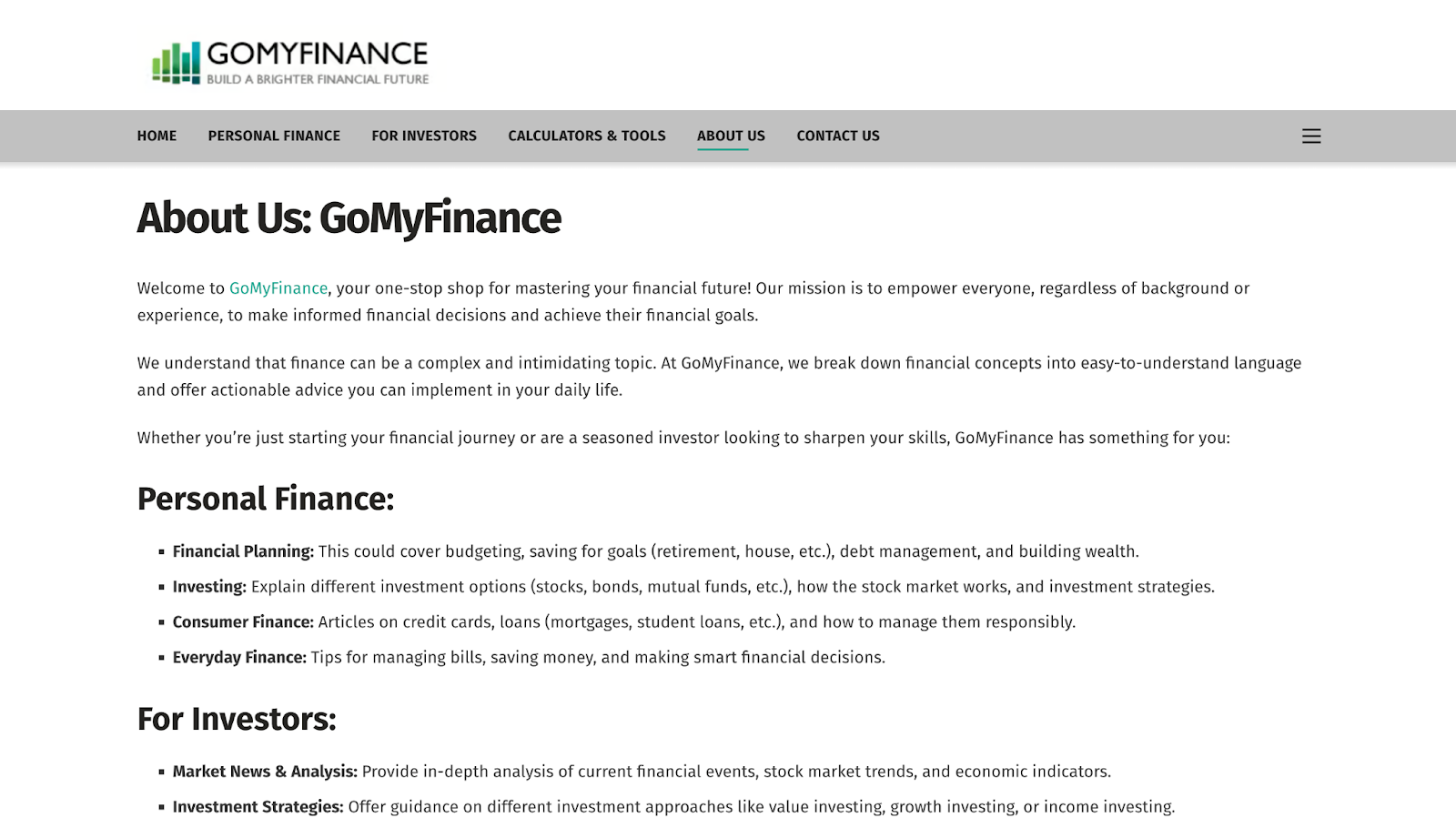
A real financial education company introduces its founders, advisors, and mission. GoMyFinance’s “About Us” page reads like an AI prompt result:
“Our mission is to empower everyone to make informed financial decisions.”
It lists no founders, no team, no partners, and no company registration data.
Even worse, the “About” content is duplicated across other pseudo-finance domains, suggesting a network of templated clones under one operator.
The same format appears across sites like GoMyFinance.online and HomelySolve.com, which ScamAdviser already flags as low-trust domains.
Contact Information — or the Illusion of It

GoMyFinance provides a contact address: 2245 Texas Dr #300, Sugar Land, TX.
A quick lookup reveals this to be a virtual office location, not a corporate suite.
Emails listed as [email protected] and [email protected] are both unverified and not linked to any official financial domain.
No LinkedIn page.
No business registration in the state of Texas.
No traceable ownership.
Everything about the contact section screams generic placeholder.
Independent Trust Scores
ScamAdviser currently rates the domain as “Likey Unsafe (24/100)”, noting hidden ownership, young age, and lack of verified operations.
User-based reviews are virtually nonexistent outside the site’s own posts. On independent aggregator sites, the domain has:
● 0 verified user reviews
● No security or privacy certifications
● No bureau accreditation or partnerships
This aligns with its real nature, which is, a content farm disguised as a finance service.
Testing the Credit Tools
Attempting to find an actual credit score feature yields nothing. Every supposed “Credit Score” button leads to an article and not a form, not a tool.
Even the “check your score” prompts redirect to long-form guides about how credit works in theory. There’s no embedded widget, no API call, no data request process.
In other words, it’s all narrative, no backend.
That alone confirms this is not a credit score platform. It’s an information shell pretending to be one.
Rating Table: GoMyFinance.com
| Category | Rating (Out of 5) | Notes |
| Transparency | ★☆☆☆☆ | No team, no regulatory details, hidden ownership |
| Functionality | ★☆☆☆☆ | No working tools or real credit data access |
| Content Quality | ★★☆☆☆ | Coherent language but shallow and repetitive |
| Security | ★★☆☆☆ | HTTPS present, but no evidence of encrypted transactions |
| Credibility | ★☆☆☆☆ | No external validation or credible affiliations |
| User Experience | ★★★☆☆ | Simple layout, easy to read, but misleading navigation |
| Overall Trustworthiness | ★☆☆☆☆ | Operates as a content shell, not a genuine platform |
Why the Low Ratings Are Justified
Transparency:
There is zero proof that GoMyFinance has any financial professionals or verified partners behind it. No FINRA, SEC, or CFPB registration is visible.
Functionality:
The supposed “credit score tool” doesn’t exist. It’s a theoretical feature repeated across multiple blog posts to generate keyword coverage.
Content Quality:
While some articles appear human-edited, they lack citations, financial formulas, or screenshots of genuine platform data. Everything reads like SEO filler, designed to signal legitimacy to Google’s crawlers.
Security:
The HTTPS certificate is baseline. There’s no visible privacy policy governing how user data would be stored — because no functional data collection actually happens.
Credibility:
No evidence of partnerships with bureaus, banks, or fintech firms. Every positive review online originates from affiliate blogs with clear promotional ties.
User Experience:
Clean interface, yes. But when navigation consistently leads you to “read more” articles instead of interactive tools, usability becomes deception.
Patterns Across the Site Network
GoMyFinance’s content structure matches other questionable domains under what looks like a repurposed CMS template.
● Same image ratio (1280x720 stock visuals)
● Same author credit line
● Identical About and Disclaimer pages
● Similar upload timestamps
This pattern suggests automated or syndicated publishing — likely using AI-assisted article generation.
These markers aren’t inherently malicious but combined with false claims of active credit tools, they cross into deliberate misrepresentation.
What It Really Is
GoMyFinance.com is not a credit score monitoring platform.
It is a synthetic SEO website engineered to capture search traffic around keywords like “credit score,” “no credit check loans,” and “financial tools.”
It repackages generic educational content to mimic authority, then subtly redirects attention toward its own network of internal links — boosting its domain authority while misleading users who expect functioning credit utilities.
In plain terms: this is not a real financial service.
Final Verdict
GoMyFinance.com positions itself as a bridge to financial empowerment but operates as a hollow shell filled with recycled content.
It fakes legitimacy through structure, borrows trust from real credit institutions by mentioning them, and exploits search behavior of users seeking genuine financial tools.
There’s no crime in running an educational blog. But there is a clear ethical issue when that blog pretends to offer services it doesn’t actually deliver.
If you’re looking for actual credit monitoring, stick with Equifax, Experian, or AnnualCreditReport.gov. They are regulated, traceable, and transparent.
GoMyFinance.com, on the other hand, should be treated as a fake platform — a carefully designed imitation of legitimacy built solely to feed the search engine, not to serve the user.
Post Comment
Be the first to post comment!