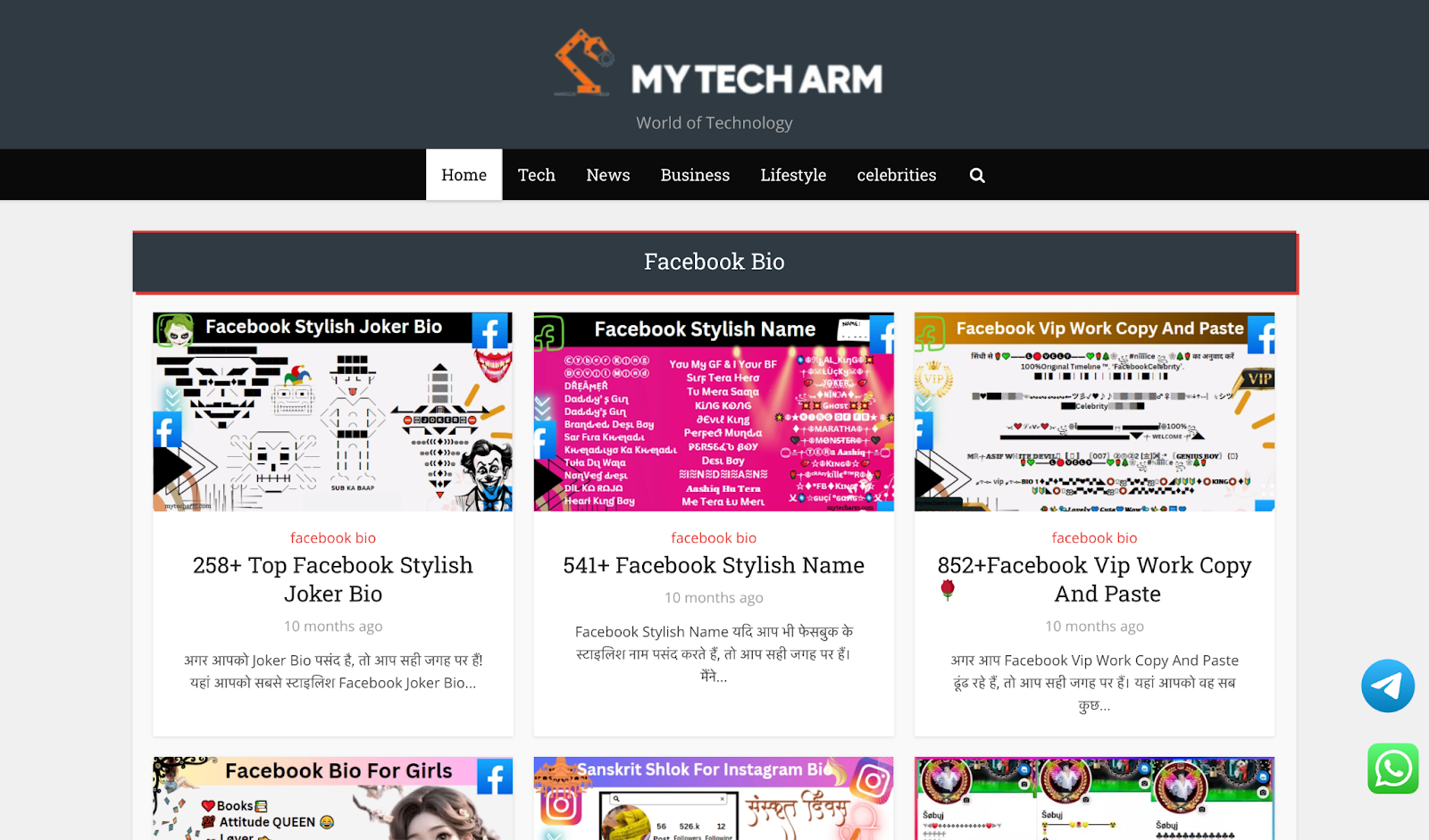
At first glance, MyTechArm.com looks like another broad technology blog. The branding leans heavily on familiar promises such as innovation, AI, gadgets, and smart solutions, and the homepage is busy with recent posts across multiple categories. Nothing appears broken. Nothing looks unfinished.
But once you stop reading individual posts and start examining how the site behaves as a whole, a different picture emerges. MyTechArm is not organized around ideas, expertise, or even readers. It is organized around search interception.
This article examines how the site operates, what kind of content ecosystem it belongs to, and why its structure matters more than any single article published on it.
A Site Built Around Queries, Not Subjects
A genuine publication usually signals what it cares about through repetition with purpose. Topics reappear, but they deepen. Writers return to ideas. Categories feel intentional.
MyTechArm does the opposite.
The site covers technology, finance, celebrity profiles, social media bios, SEO advice, gambling-adjacent content, and general lifestyle material, all under the same roof, without any visible hierarchy. These topics do not connect thematically, and they are not meant to.
Instead, each article functions as a standalone landing page designed to capture a specific long-tail search query. A Facebook bio page does not support a finance article. A celebrity net-worth post does not relate to a tech explainer. They coexist only because they can be indexed.
This is not topical diversity. It is topic stacking.
Why Short, Template-Driven Content Dominates
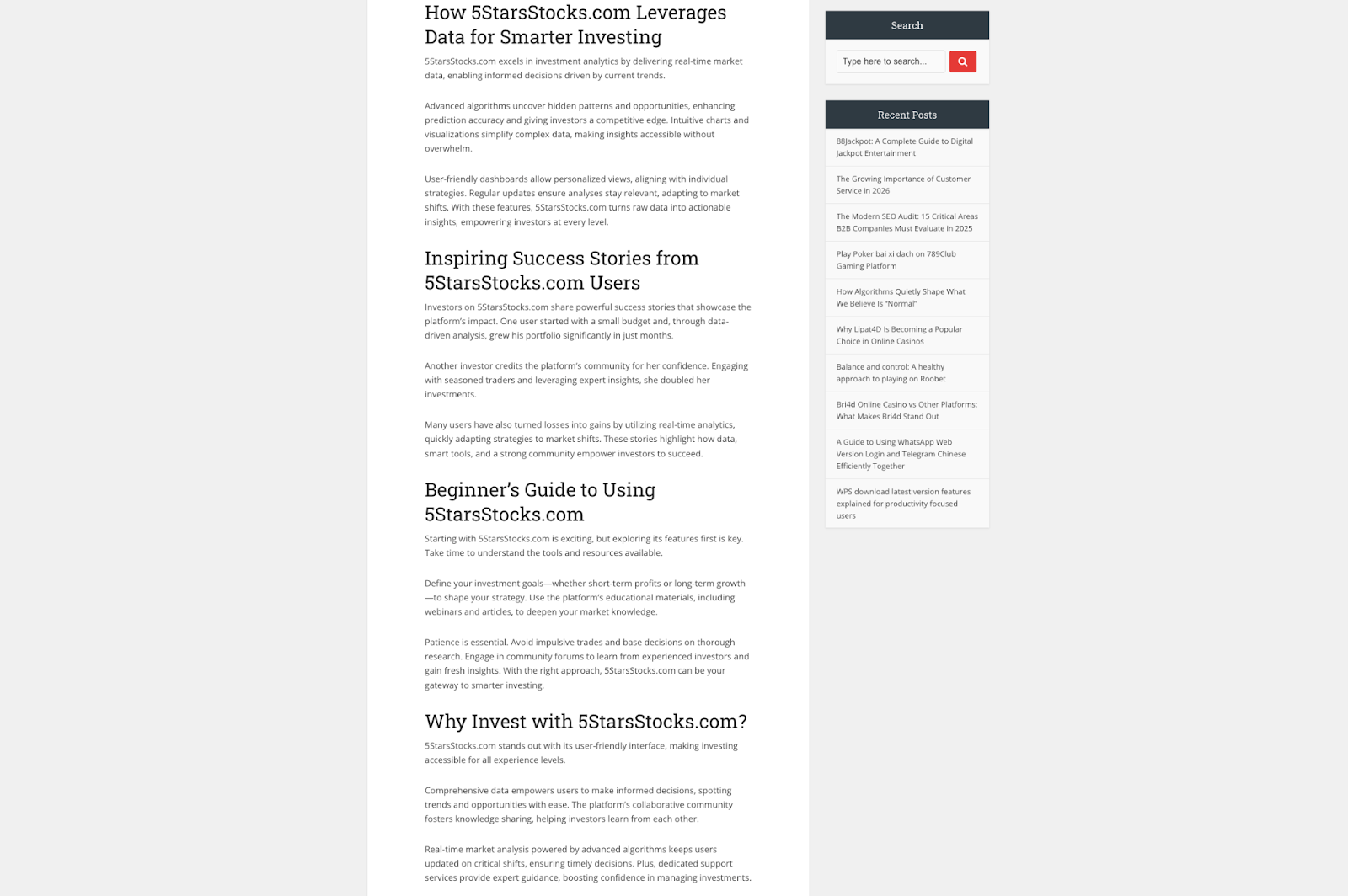
The overwhelming majority of visible posts follow a predictable pattern: narrow intent, short length, minimal sourcing, and neutral language. They aim to answer just enough to satisfy a search query without inviting follow-up reading.
This explains why claims are made without citations or external references, why there is no visible editorial voice or perspective, and why specificity is consistently avoided.
Specificity requires accountability. The writing stays broad, safe, and interchangeable. One page could disappear tomorrow without affecting the rest of the site.
That is not a flaw in execution. It is a design choice.
Contact Details That Raise More Questions Than Answers

Transparency is not just about having a contact page. It is about internal consistency.
On MyTechArm, the listed contact details do not align cleanly. The email address uses a different domain than the site itself. The phone number uses a country code that does not match the listed physical address. No individual editor, author, or owner is clearly identified.
None of these elements alone prove wrongdoing. Together, they suggest a templated operational setup, often seen in networks that manage multiple content sites under shared infrastructure.
When accountability is diffuse, trust becomes optional.
The Quiet Presence of Gambling and Affiliate Signals

One of the more revealing aspects of MyTechArm is not found in its main articles, but in its peripheral structure. Gambling-related keywords appear in footer elements and tags rather than in prominent sections.
This subtlety matters.
Overt promotion can repel users and trigger scrutiny. Background placement, on the other hand, allows monetizable content to exist without drawing attention to itself. Readers are never clearly told when content shifts from informational to commercial intent.
The absence of explicit affiliate or sponsorship disclosure does not make monetization disappear. It simply makes it harder for readers to recognize.
What MyTechArm Is Optimized For
Once you step back, the site’s priorities become clear.
MyTechArm is optimized for volume, not authority.
For single-visit users, not return readers.
For search engines, not editorial continuity.
The structure, content length, topic selection, and monetization signals all align toward one goal: publishing as many indexable pages as possible with minimal friction.
Seen through this lens, the lack of author bios, sourcing, or thematic focus is not an oversight. It is efficient.
How Readers Should Interpret the Site
MyTechArm is not dangerous in the dramatic sense. It does not spread obvious falsehoods. It does not aggressively scam users. Its risk lies in something quieter: indifference to consequence.
For low-stakes queries such as social media bios or casual curiosity, the site functions as intended. For anything involving money, legality, health, or technical decision-making, it offers no reliable foundation.
The site does not ask to be trusted. It simply asks to be clicked.
Final Perspective
MyTechArm.com is not a failed publication or a confused startup blog. It is a fully realized example of a modern SEO-driven content operation.
It produces pages, not positions.
It values reach over responsibility.
It trades depth for scale.
Once you understand that, the site stops being puzzling. It becomes predictable.
And predictability, in this case, is the clearest signal of what MyTechArm is, and what it is not.
Post Comment
Be the first to post comment!