
The Best Place to Buy, Sell, and Pay with Cryptocurrency In USA 2022
Best Crypto App For Beginners | Best Crypto Exchange In USA 2022 Most youths in the USA are earning money from Cryptocur...
India's goods trade deficit came down in September 2026, mainly because the country's exports grew much faster than its imports. India's merchandise trade deficit narrowed to $30.21 billion from $33 billion in September last year, as imports rose to $74.61 billion from $69.08 billion. The figures were released by the Ministry of Commerce and Industry on October 15, 2026.
In simple terms, the trade deficit is the gap between what India sells to other countries and what it buys from them. When India buys more than it sells, that gap is called a deficit. In September, India still bought more than it sold, but the gap became smaller than it was a year ago because exports jumped sharply while imports rose only a little.
India's Goods Trade Deficit Eases to $30 Billion as Exports Rise in September 2026
India's goods trade deficit came down in September 2026, mainly because the country's exports grew much faster than its imports. India's merchandise trade deficit narrowed to $30.21 billion from $33 billion in September last year, as imports rose to $74.61 billion from $69.08 billion. The figures were released by the Ministry of Commerce and Industry on October 15, 2026.
In simple terms, the trade deficit is the gap between what India sells to other countries and what it buys from them. When India buys more than it sells, that gap is called a deficit. In September, India still bought more than it sold, but the gap became smaller than it was a year ago because exports jumped sharply while imports rose only a little.
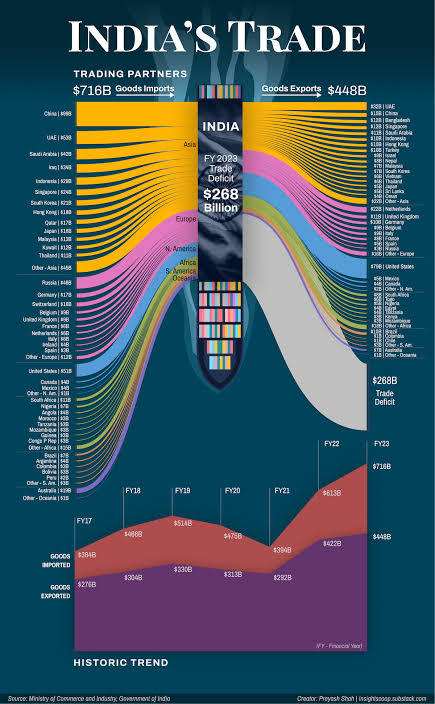
The biggest story of the month was the strong rise in exports. India's merchandise exports rose 23.04 per cent to $44.40 billion in September 2026, compared to $36.08 billion a year ago. This means India sold goods worth about $8.3 billion more abroad than it did in the same month last year.
Imports, on the other hand, rose at a much slower pace. India's exports increased by 23% to $44.4 billion in September, reducing the goods trade deficit to $30.2 billion as imports rose by 8% to $74.6 billion. So exports grew nearly three times faster than imports. This difference in speed is exactly why the deficit shrank. The trade deficit narrowed by $2.79 billion compared with September 2025.
Commerce Secretary Rajesh Agrawal spoke about the export performance during a press briefing. If you look at merchandise exports in September, they are at $44.40 billion, which is 23.04 per cent higher than last September, he said.
An independent view came from a leading rating agency. India's merchandise exports expanded by over 20% for the second consecutive month in September 2026, even as growth in such imports cooled to a 6-month low of 8.0%, amid a sharp contraction in gold imports, said Aditi Nayar, chief economist at ICRA. This contained the merchandise trade deficit at $30.2 billion in the month, lower than the $33 billion seen in September 2025.
The gains were not spread thinly. A few key sectors did most of the heavy lifting.
Electronics was the standout performer. Electronics recorded particularly rapid growth, up 70.44% to $5.31 billion, while engineering-goods exports increased 20.91% to $12.17 billion. A jump of more than 70 per cent in a single category in one year is unusually large, and it shows how quickly India's electronics manufacturing is growing.
Engineering goods are another important part of the export basket. This category includes machinery, auto parts, industrial equipment and metal products. Because it is a large category in absolute terms, its 21 per cent rise added a big chunk to the overall export figure.
What makes the September numbers more reassuring is that the growth was broad and did not depend only on oil. The expansion was not confined to petroleum, as non-petroleum exports rose from $31.37 billion to $38.18 billion in September. This matters because petroleum exports can rise and fall sharply with global oil prices. When non-oil exports grow strongly, it suggests the improvement is more stable and comes from real manufacturing activity rather than just price swings.
Beyond electronics and engineering, several other sectors also added to the month's strength. The growth was supported by higher shipments of electronic goods, petroleum products, engineering goods, chemicals and agricultural products. Chemicals and farm goods, in particular, continue to be steady contributors to India's export earnings.
If imports had risen as fast as exports, the deficit would not have come down. The main reason imports stayed low was a very sharp drop in gold buying. Gold imports took a nosedive, down 81%, mostly because of higher duties.
Gold is one of India's largest import items, so any big change in gold buying has a direct effect on the total import bill. When gold imports fall this steeply, the overall import figure is pulled down even if other imports are rising. Even with less gold and fertilizer coming in, India's import bill stayed high due to higher electronic imports and higher crude shipments.

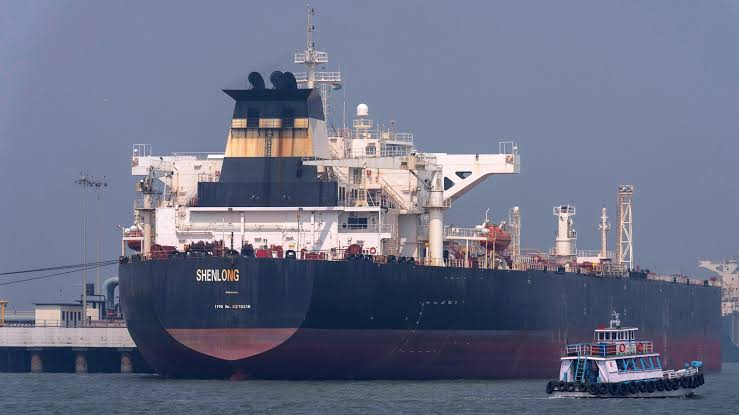
So the picture on imports is mixed. Lower gold and fertiliser purchases helped keep the bill in check, but these were partly offset by higher spending on crude oil and on electronic components that feed India's growing manufacturing.
One point is worth understanding clearly, because the headline can be read in two ways. The deficit became smaller compared with the same month last year, but it became slightly larger compared with the previous month.
At $30.21 billion the merchandise trade deficit was lower than that in the same month last year but higher than the deficit in August 2026, when it stood at $26.86 billion. The month-on-month details show how this happened. Merchandise exports rose to $44.40 billion in September from $43.81 billion in the previous month, while imports increased to $74.61 billion from $70.67 billion.
In short, both exports and imports rose from August to September, but imports rose by more during the month, which pushed the monthly gap slightly wider. This is partly linked to the festive season in India, when demand for goods goes up and imports naturally increase. The year-on-year comparison, which is the one the government usually highlights, still shows clear improvement.
So far these numbers cover only goods, which are physical products. India also earns a large amount from services such as software, information technology, consulting, finance and travel. When services are included, the trade picture looks even stronger.
India's overall exports, including merchandise and services, grew 10.99 per cent to an estimated $80.75 billion from $72.76 billion a year ago. At the same time, overall imports increased to $94.05 billion from $86.93 billion, while the combined trade deficit narrowed to $13.30 billion from $14.17 billion.
This combined deficit of $13.30 billion is far smaller than the goods-only deficit of $30.21 billion. The reason is that India runs a large surplus in services, meaning it sells far more services abroad than it buys. This services surplus helps cancel out a big part of the goods deficit and keeps India's overall trade position much healthier than the goods figure alone would suggest.
One caution applies here. The services numbers for September are estimates and may be revised later. The latest firm data from the Reserve Bank of India covers only up to August 2026, so the September services figure, and therefore the combined trade figure, is based on an estimate until the full data arrives.

September also helped India close out a strong three-month period. According to the ministry's presentation, India's overall exports reached an estimated $242.6 billion during July to September 2026, the highest ever for the second quarter, compared to $233.6 billion in April to June.
This is an important milestone. It shows that India's export momentum is not limited to a single good month but has held up across a full quarter, and at a record level for that part of the year. A record quarter suggests that the strength seen in September is part of a wider trend rather than a one-time spike.
Looking at the longer picture across the financial year gives a more complete view, and here the message is more balanced.
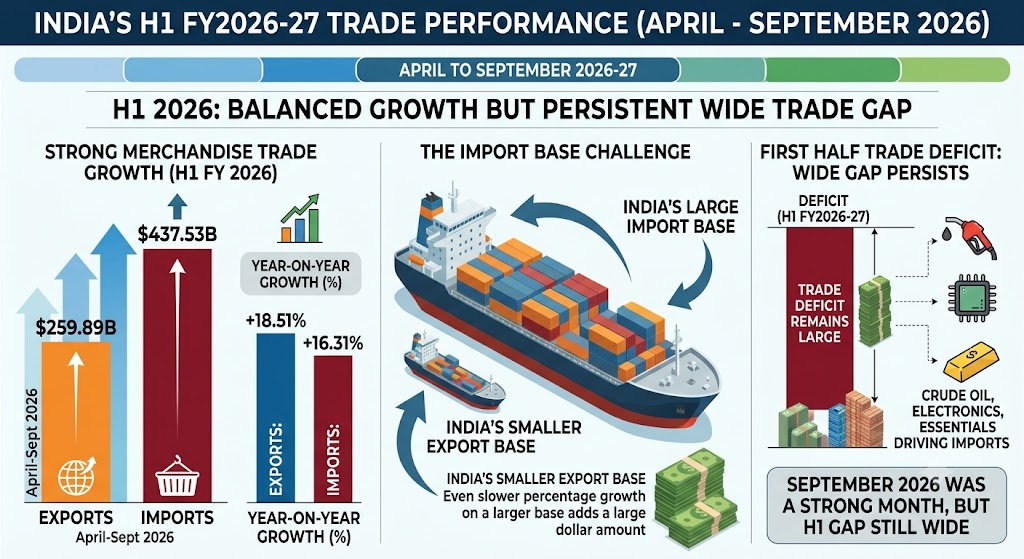
During April to September 2026, merchandise exports increased 18.51% to $259.89 billion, while imports climbed 16.31% to $437.53 billion. Compared with the previous year, merchandise exports during April to September 2026-27 grew 18.5% to $259.89 billion against $219.30 billion in the same period last year.
So over the full six months, both exports and imports grew strongly. Exports grew a little faster in percentage terms, which is a good sign. However, because India's import base is much larger than its export base, even a slightly slower percentage growth in imports still adds a large amount in dollar terms. This is why the deficit for the first half of the year as a whole has not shrunk as much as the single month of September might suggest.
In other words, September was a strong month that narrowed the year-on-year gap, but the overall half-year trade gap remains wide because of the sheer size of India's import bill, driven heavily by crude oil and other essential purchases.
The trade deficit is one of the most closely watched economic figures in India. A large and rising deficit can put pressure on the rupee and on the country's foreign exchange situation, because India needs more dollars to pay for the goods it buys than it earns from selling goods. A narrowing deficit, like the one seen in September, eases some of that pressure.
The September data carries a few encouraging signals. First, the rise in exports was led by manufacturing categories such as electronics and engineering goods, not just by higher commodity prices. This points to real growth in India's production and export capacity. Second, the strength in non-petroleum exports shows that the improvement is broad-based. Third, the record second quarter suggests the momentum is steady rather than temporary.
At the same time, there are reasons to stay cautious. The monthly deficit was wider than in August, the first-half deficit remains large, and part of the drop in imports came from a sharp fall in gold buying linked to higher duties rather than from a lasting change in demand. The services figures are also still estimates.
September 2026 was a strong month for India's foreign trade when measured against the same month a year earlier. India's trade deficit dropped to $30.2 billion in September 2026, thanks to a big jump in exports, up 23% from last year. Imports grew too, but at a slower pace, keeping the overall gap smaller than before.
The main takeaways are simple. Exports rose sharply, led by electronics and engineering goods. Imports rose only modestly, helped by a steep fall in gold purchases. The goods deficit narrowed year-on-year to $30.21 billion, and the combined goods-and-services deficit came down to just $13.30 billion. India also recorded its highest-ever second-quarter exports.
For the months ahead, the key questions will be whether electronics and engineering exports can keep growing at this pace, whether crude oil prices stay manageable, and whether the strong services earnings continue to balance out the goods deficit. If those trends hold, the improvement seen in September could mark the start of a steadier phase for India's trade, rather than just a single good month.

Best Crypto App For Beginners | Best Crypto Exchange In USA 2022 Most youths in the USA are earning money from Cryptocur...

Keeping track of your crypto portfolio is tough, even for the expert. You could make use of a crypto portfolio manager a...

An outfit for your little one which is comfortable and stylish. When it comes to dressing up babies, comfort and style a...

Latest Update about - PIL Filed Against Blockbuster 'RRR' At Telangana High Court!The Telangana High Court rejected a PI...