In the ever-evolving world of internet slang, acronyms are shorthand that helps people express complex ideas with just a few letters. One such term that has gone viral in recent years is SYBAU. At first glance, it looks like a random jumble of capitals but, like many other online buzzwords, it carries a clear meaning in digital communication.
What SYBAU Stands For
SYBAU is an abbreviation for “shut your b*tch ass up.” In essence, it’s a forceful way of telling someone to be quiet. The phrase may seem crude, and that’s because its very construction comes from a vulgar expression that’s been condensed into a five-letter acronym used widely online.
Despite its offensive roots, the term has rapidly spread far beyond its literal meaning due to internet culture’s tendency to “meme-ify” expressions and embed them into comment threads, jokes, and reactions.
How SYBAU Is Used Online
SYBAU does not have a single tone or use case context matters. In many cases, it is employed as a playful jab between friends, where the intent is humorous rather than hostile: someone might mockingly tell a friend “SYBAU ��” after a long, exaggerated comment.
You’ll commonly see SYBAU used in:
● TikTok comments: as a quick reaction to a hot take or viral clip. Many creators use it alongside captions or as part of meme chains. For instance, you can find multiple examples on sites that explain trending slang like this one.
● Twitter/X replies: when engaging in snarky debate or shutting down an opinion.
● Gaming chats or group messages: where quick, dismissive responses are part of the banter.
Because it’s shorthand for a phrase with mild profanity, the tone can be playful among friends or flat-out rude when directed at strangers.
Examples from Real Online Use
To make your article more interactive, you can link directly to pages with real examples. Here are a few reliable sources you might reference:
● Merriam-Webster Slang entry: real examples of SYBAU in social media context.
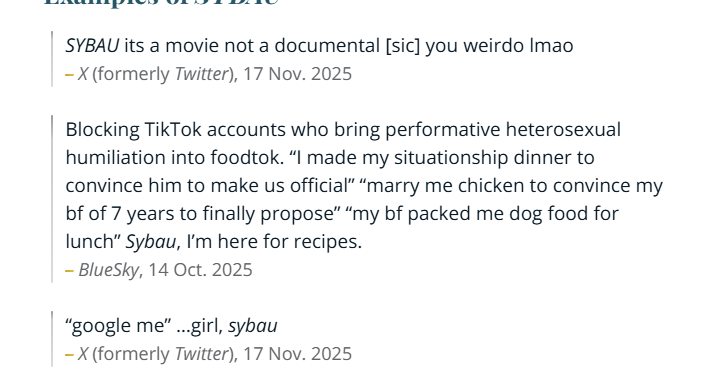
● Know Your Meme guide: explanation of the term’s spread on TikTok (with user clips).
● Punspanda slang article: contextual use cases and origin.
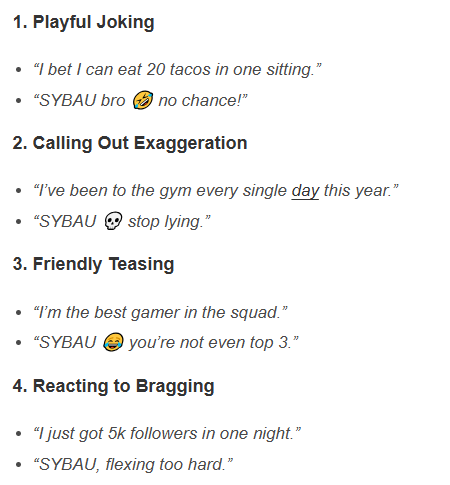
These links help ground your discussion and give your readers visual/contextual proof of how the term is actually used.
Where It Came From: A Brief History
Although SYBAU feels like a recent trend, linguists trace its existence back to the early days of internet forums and Urban Dictionary definitions with entries resembling the modern meaning appearing as early as 2003.
However, its viral momentum is far more recent. Around late 2024 and into 2025, the term exploded across TikTok, where clips combining SYBAU with humor, metaphor, and even ironic misdefinitions (like fake positive meanings) propelled it into mainstream social media circulation.
Is SYBAU Offensive? How Tone Changes Everything
At its core, SYBAU comes from a phrase that is explicit and coarse. That means it will almost always carry a dismissive, confrontational undertone unless you and your audience explicitly agree that it’s playful.
For example:
● Among close friends who often joke in similar ways, it might be a light-hearted interruption rather than an insult.
● In public comments, replies to strangers, or professional settings, SYBAU can easily be perceived as rude or disrespectful.
This dual nature both humorous and abrasive, is why slang like SYBAU often sparks debate about digital etiquette.
Why This Slang Spreads So Fast
Terms like SYBAU become cultural currency because they’re short, punchy, and loaded with attitude. They reflect how Gen Z and Gen Alpha communicate online: with speed, irony, and a flair for insider language that marks group identity.
Moreover:
● Acronyms conceal profanity and can slip past moderation filters or social norms more easily than the full phrase.
● Humour and irony make them shareable and meme-worthy.
● Rapid short-form platforms like TikTok and X magnify even niche slang into widespread trends.
Polite and Playful Alternatives to SYBAU
| Situation | Alternative Phrase | Tone / Effect |
| When someone is talking too much | “Okay, that was a lot.” | Light, humorous |
| When a comment feels unnecessary | “Let’s move on.” | Calm, neutral |
| When you disagree politely | “Let’s agree to disagree.” | Respectful |
| When someone is being dramatic | “You’re doing too much right now.” | Playful |
| When you want to pause the conversation | “Let’s take a breather.” | Friendly |
| When you want to set a boundary | “Please stop.” | Direct, firm |
| When a debate is going nowhere | “Not the hill to die on.” | Sarcastic but mild |
| When someone is off-topic | “That’s not relevant here.” | Professional |
| When you want to disengage | “I hear you, but let’s move on.” | Polite closure |
Final Thoughts: Be Aware of Context
If you’re writing for an audience interested in internet culture, SYBAU is a compelling example of how language evolves online. It’s not just a phrase it’s a snapshot of digital communication in the 2020s: fast, irreverent, and steeped in context.
While it may be playful in some circles, it’s important to highlight that the term’s roots are not polite and it should be used with care. Linking to real examples helps your readers see how it’s actually applied, not just what it means in theory.
Post Comment
Be the first to post comment!