
Too Scared to Argue? A 56-Year-Old in Guangzhou Will Do It for $26
If confrontation makes your stomach turn, a man in southern China has a proposition. Pay him ¥188, roughly $26 by the vi...
The Disney Character.AI deal has become one of the most closely watched stories in consumer technology, because it shows how a company with millions of users can still run out of road. After the chatbot startup Character.AI filed for bankruptcy, many of its employees are now set to take jobs at The Walt Disney Company. The arrangement pairs a cash-burning artificial intelligence startup with one of the world's largest entertainment companies, and it arrives just as Disney sharpens its own AI strategy under new leadership.
What makes the situation unusual is the structure. Disney is not buying Character.AI outright. Instead, it is hiring most of the people, licensing a slice of the technology, and leaving the rest of the business to be resolved in court. The key point for readers is this: as of 19 October 2026, the agreement is proposed, not completed, and it remains open to higher bids.
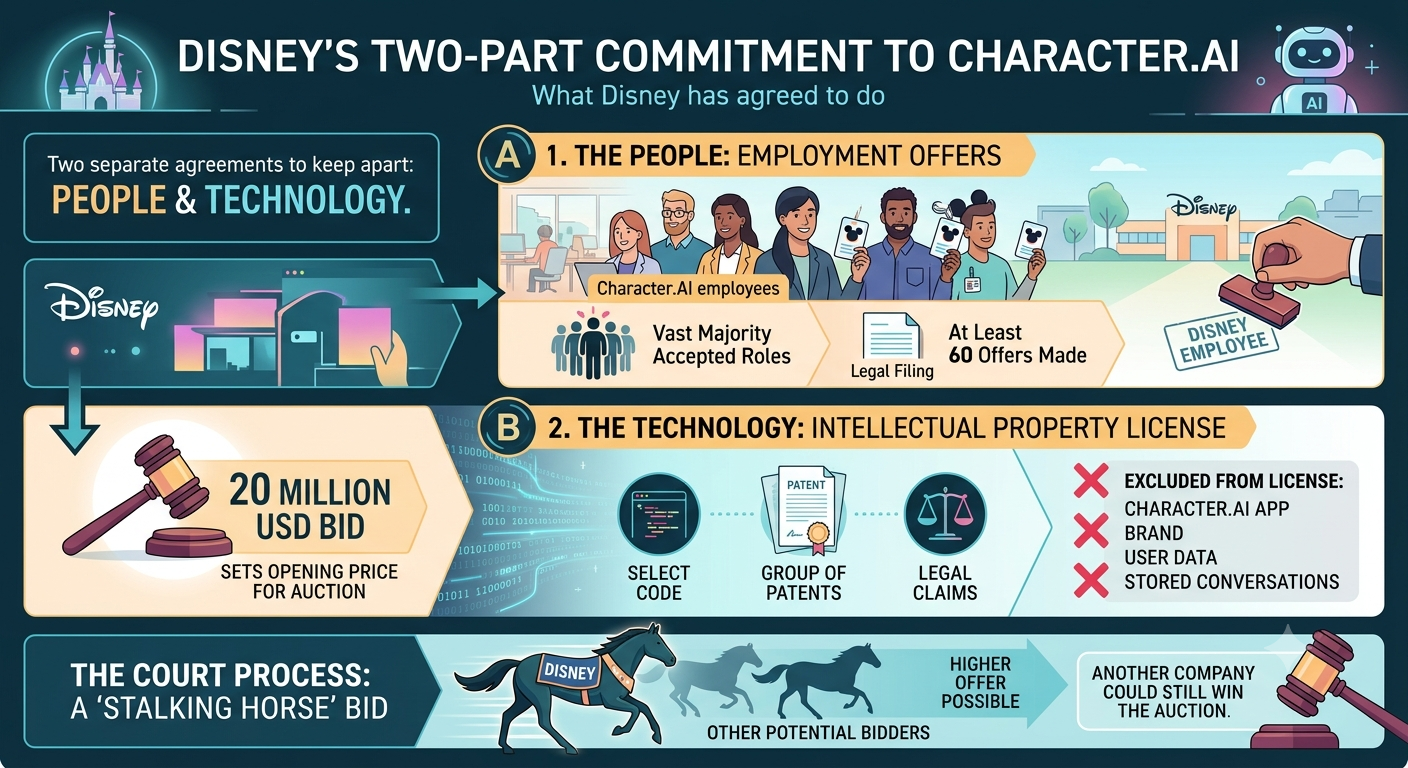
Disney's commitment has two separate parts that are easy to confuse, so it helps to keep them apart.
First, on the people side, a legal filing Bloomberg reported showed that Disney agreed to make employment offers to at least 60 Character.AI employees, representing most of the workforce. The filing also stated that the vast majority of those offered roles accepted them.
Second, on the technology side, Disney made a separate 20 million US dollar bid for a license to certain Character.AI intellectual property and technology, a figure that sets the opening price for a court-supervised auction. The license is described as non-exclusive and perpetual, covering selected code and a group of patents, along with certain legal claims held by the company. Importantly, the Character.AI app, brand, user data, and stored conversations are excluded from that license.
Because this is a court process, the arrangement functions as a stalking horse bid. That means another company could still come forward with a higher offer.
The headline number has firmed up as more filings have been reviewed. According to a Chapter 11 court filing reported by Business Insider, Disney plans to pay roughly 60 million US dollars a year for 66 employees from the startup. Of those 66, 56 had already resigned from Character.AI, while 10 were waiting on United States work authorization matters.
For context on scale, Character.AI had about 86 full-time employees at the end of September, according to a review of the court filings. That makes the Disney offers a clear majority of the remaining staff.
The most prominent hire happened before the bankruptcy. Karandeep Anand, who was named Character.AI's chief executive in June 2025, left the startup to become Disney's first chief technology officer, starting on 2 October and reporting directly to Disney chief executive Josh D'Amaro. Colin Adams now holds the chief executive post at Character.AI and signed the declaration supporting the bankruptcy filing.
This is the section where precision matters most, because several large numbers are circulating and they do not all mean the same thing. Each figure below comes from reporting on the court filings, and each covers something different. All amounts are in US dollars.
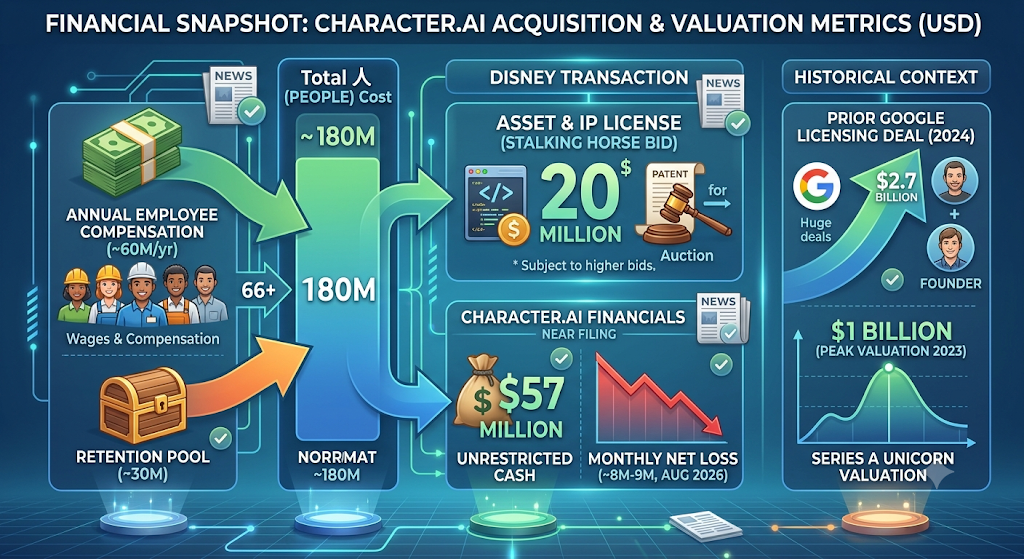
Bankruptcy filings disclose a roughly 30 million US dollar retention pool to keep Character.AI staff in place, described as part of an estimated 180 million US dollars in total compensation and retention spending over the next three years. In other words, the widely cited 180 million dollar figure is a multiyear total for people costs, not a single upfront payment and not the price of the technology.
A few cautions for readers. The annual compensation, the retention pool, and the three-year total are overlapping views of the same employment arrangement rather than separate bills to be added together. The 20 million dollar license is genuinely separate from the employment costs, and it would be paid into the bankruptcy estate for the benefit of creditors, whereas the compensation and retention spending relate to the people Disney is hiring. Disney has not publicly broken down these figures itself, and Disney declined to comment on the proposed sale.
| Financial item | Reported amount (USD) | What it covers | Verification status |
|---|---|---|---|
| Annual employee compensation | About 60 million per year | Wages and compensation for the roughly 66 hired staff | Reported from the Chapter 11 filing via Business Insider; Disney declined to comment |
| Retention pool | About 30 million | Incentive payments to keep Character.AI staff through the transition | Reported from the bankruptcy filing |
| Total people cost over three years | About 180 million | Combined compensation and retention over a multiyear period | Reported from the bankruptcy filing |
| Asset and IP license (stalking horse bid) | 20 million | Non-exclusive, perpetual license to selected code and patents, plus certain claims | Confirmed in filing; subject to higher bids at auction |
| Character.AI cash at filing | About 57 million | Unrestricted cash on hand, with no funded debt | From the bankruptcy declaration |
| Monthly net loss near filing | About 8 million to 9 million (roughly 8.2 million in August 2026) | Operating cash burn | From the chief executive's declaration |
| Prior Google licensing deal (2024) | About 2.7 billion | Licensed technology and returned founders to Google | Reported by The Wall Street Journal in 2024; earlier transaction |
| Peak valuation (2023) | About 1 billion | Series A unicorn valuation | Widely reported |
A proposed agreement is not a completed transaction. Until a court approves the sale and no higher bid prevails, these commitments remain conditional.
The core problem was simple to state and hard to fix: it cost far more to run the service than the service brought in. Despite retaining millions of active users, Character.AI was losing about 8 million to 9 million US dollars per month.
The filings put concrete numbers on the strain. The company reported monthly compute spending of about 13.8 million US dollars in 2024 and roughly 10 million in 2025. Through the first eight months of 2026 it spent about 56.1 million on compute, close to 45 percent of operating expenses. Cost cutting helped but did not close the gap. By August 2026 monthly operating expenses excluding legal fees had fallen to about 13.3 million, with net cash burn of about 8.2 million.
In its own words, the company said that high costs, together with potential litigation-related liabilities and regulatory engagement, had left it unable to generate enough cash flow to support the business in its current form. At filing, Character.AI reported 50 million to 100 million US dollars in both assets and liabilities, and about 57.4 million in unrestricted cash across several accounts, with no funded debt.
Character.AI was a signature product of the generative AI boom. It was founded in 2021 by Noam Shazeer and Daniel De Freitas, both of whom had previously worked on AI at Google. The platform let people chat with AI versions of fictional characters, historical figures, and user-created personas, and it attracted a large and unusually engaged audience. The company reported around 12 million monthly active users who spent roughly 120 minutes a day on the platform on average, down from a peak of more than 20 million monthly active users reported around February 2025.
The business raised significant capital. It raised about 150 million US dollars in a Series A round at a 1 billion dollar valuation, and by the time of bankruptcy had raised nearly 200 million dollars in total.
The earlier Google transaction is central to understanding the company's trajectory. In 2024, Google signed a licensing deal with Character.AI valued at about 2.7 billion US dollars, which brought Shazeer, De Freitas, and part of the research team back to Google. The licensing structure gave Google immediate access to Character.AI's technology without waiting for regulatory clearance, rather than a full acquisition. Shazeer went on to help lead Google's Gemini project, and later departed Google for OpenAI. The pattern of that deal, hiring the team and licensing the technology while leaving the corporate entity in place, is strikingly similar to what Disney is now proposing.
Disney's interest fits a broader strategy under its current leadership. Josh D'Amaro took over as Disney chief executive in March 2026, and he has pushed to make the company more technology-forward, with Disney+ positioned as a digital hub for film, television, gaming, and other experiences.
Hiring an experienced consumer AI team in one move is attractive in a market where that talent is scarce and expensive. As CTO, Anand is set to oversee enterprise technology, infrastructure, data and AI platforms, product, and engineering, with several members of Character.AI's technical team expected to join him. The team brings hands-on experience in building interactive AI characters, running them at scale, and managing the moderation and safety challenges that come with emotionally engaging chatbots. For a company whose business is beloved characters and fan relationships, that expertise is directly relevant.
The timing is notable. Disney's move to add Character.AI staff came about two weeks after it laid off several hundred employees, including some technology workers. That contrast, cutting staff in one area while paying a premium for specialized AI talent in another, underscores how selectively companies are investing in AI capability.
Character.AI entered bankruptcy carrying significant legal and regulatory weight, and it is important to separate allegations from established findings.
On child safety, the company faces serious litigation. It was sued by the mother of a 14-year-old boy who said her son became fixated on one of the platform's chatbots before his death by suicide, and it has faced government investigations over child-safety concerns. Character.AI argued that chatbot-generated speech was protected by the First Amendment, a defense a federal judge rejected at an early stage of the case in May 2025. In January 2026, Character.AI and Google agreed to settle five lawsuits brought by families, including that case. These are claims and settlements; a settlement is not an admission of legal liability.
User data has also drawn official attention. Forty state attorneys general filed a notice of interest in the bankruptcy case, calling for protections on consumer data handled in the proceedings. This is one reason the exclusion of user data and conversations from the Disney license is significant.
There is also a copyright backstory involving Disney itself. About a year before hiring Anand, Disney accused Character.AI of infringing its copyrights and sent a cease-and-desist letter demanding the removal of Disney characters from the platform, which Character.AI did. The two companies went from legal confrontation to a hiring and licensing relationship within roughly a year.

For now, the service continues, but its future is uncertain. The license Disney is pursuing does not include the app, the brand, user data, or stored conversations, which means buying the technology would not automatically keep the consumer product alive. If no higher or better offer emerges, Disney would acquire the license once the sale order is final, and the Character.AI platform would be wound down.
In plain terms, users should understand that the platform they use is tied to the outcome of the auction. A different bidder could emerge who wants to operate the service, or the consumer app could be shut down even as the underlying technology lives on inside Disney. The handling of personal data and past conversations is an open question that regulators are watching closely.
Several important points are still undecided as of 19 October 2026.
The sale runs through a court-supervised Section 363 process, and competing bids are explicitly allowed. The process is expected to conclude in late November or early December 2026. Until then, the key unknowns include whether a higher bidder appears, whether anyone commits to operating the consumer app, how user data will be protected, and the final terms a judge approves.
Readers should treat current figures as reported from filings rather than finalized outcomes. Disney has not offered its own public breakdown of the compensation and retention numbers, and the deal's status is proposed and conditional, not closed.
This story is a case study in the economics of consumer AI. A product can achieve enormous engagement and still fail if each interaction costs more to deliver than it earns. In 2024, Character.AI's revenue covered only about 3 percent of its operating expenses, rising to roughly 11 percent in 2025 and about 40 percent by August 2026, an improving trend that still was not enough.
The deal structure also matters for the industry. Hiring the team and licensing the technology, rather than acquiring the whole company, has become a recurring template, and the Google and Disney transactions both follow it. It lets large companies absorb scarce AI talent quickly while sidestepping some of the complexity of a full acquisition. That approach raises hard questions for startup founders and investors about how much of a venture's value lives in its people versus its corporate entity, and about what happens to users and creditors when the shell is left behind.
Finally, the gap between Character.AI's past 1 billion dollar valuation and the 20 million dollar opening bid for part of its technology is a sobering public marker. It suggests that parts of the companion-AI market were priced for a future that the underlying unit economics could not yet support.
The significance of the Disney Character.AI deal lies less in any single number and more in what it reveals. A heavily used AI product collapsed under its own operating costs and legal exposure, its most valuable asset turned out to be its people, and a legacy entertainment company moved fast to absorb that talent while a court decides the fate of everything left over. As the bankruptcy auction plays out into late 2026, the outcome will help define how the next wave of consumer AI products is valued, staffed, and, when necessary, unwound.

If confrontation makes your stomach turn, a man in southern China has a proposition. Pay him ¥188, roughly $26 by the vi...
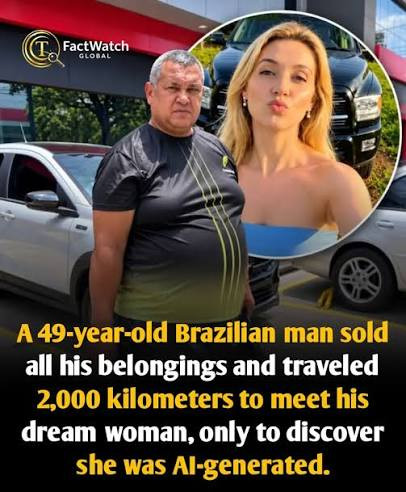
A 49-year-old bricklayer sold almost everything he owned and spent more than 36 hours on a bus, convinced he was travell...
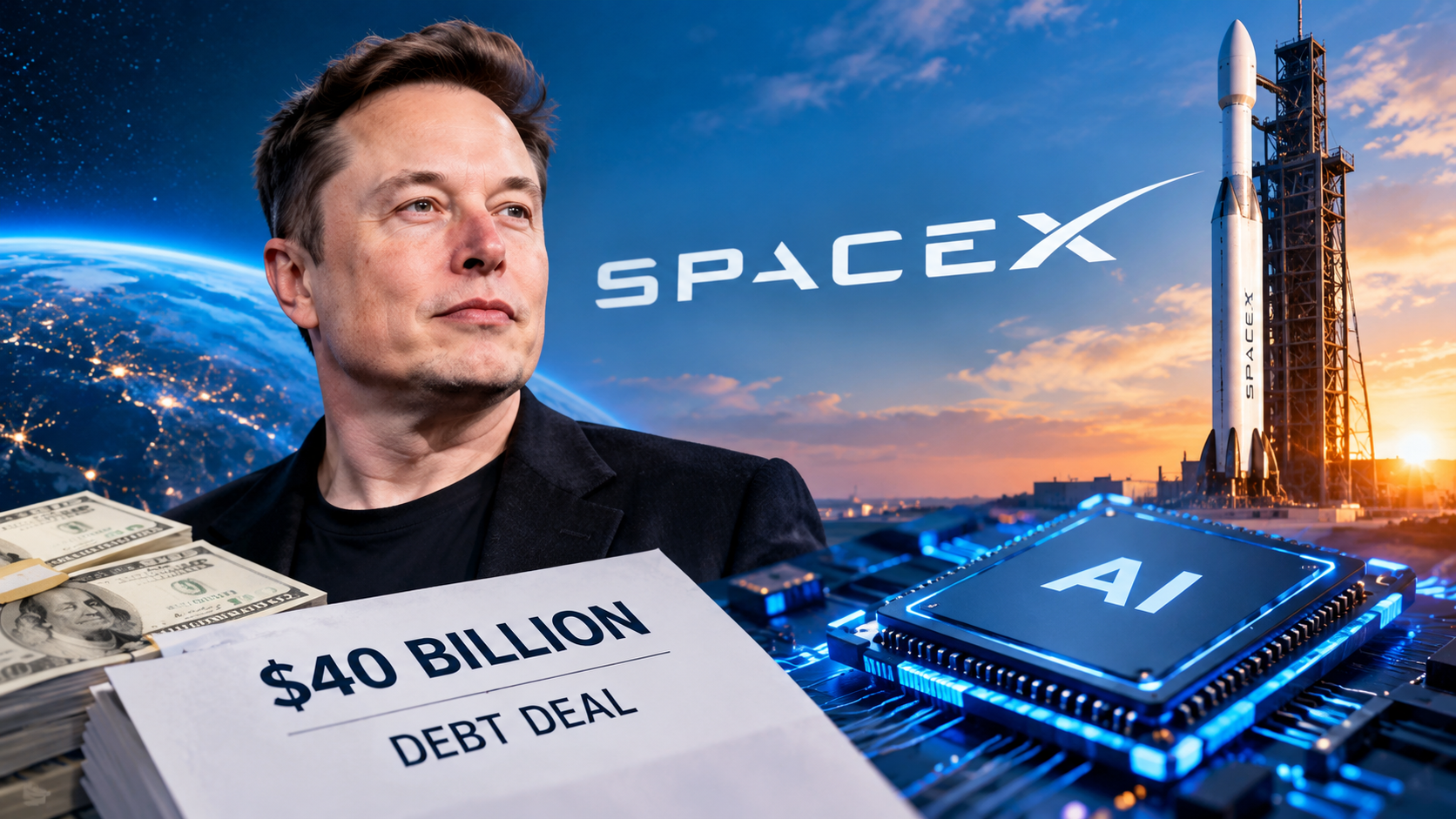
Elon Musk said on Sunday, October 25, 2026, that SpaceX had closed $40 billion in debt financing to buy graphics process...

Tom Brady and Candice Swanepoel are reportedly dating, according to a wave of entertainment reporting that began on Satu...