
Too Scared to Argue? A 56-Year-Old in Guangzhou Will Do It for $26
If confrontation makes your stomach turn, a man in southern China has a proposition. Pay him ¥188, roughly $26 by the vi...
Apple sold through its launch allocation of the iPhone Duo in roughly half an hour on Friday, 16 October 2026. Pre-orders opened at 5 a.m. Pacific Time, and by 5:30 a.m. Apple's online store was quoting a delivery date of 25 January 2027 for every configuration in the United States. The first customers will receive the phone on Friday, 23 October.
Apple called demand "nothing short of extraordinary." Bloomberg's Mark Gurman, writing in his Power On newsletter on Sunday, 18 October, said Apple knew the device faced severe supply constraints, chose to open pre-orders in more than 70 countries anyway, and in doing so made a "major mistake." The gap between those two accounts is the story. As of 19 October 2026, no part of Apple's launch plan has shifted, and no fresh order can arrive in 2026.
The iPhone Duo went from launch-day delivery to a three-month wait in under an hour. Apple opened pre-orders at 5 a.m. Pacific Time on 16 October 2026 in the United States and more than 70 other countries and regions. The first orders are set for delivery on Friday, 23 October. A further 28 countries and regions follow on 30 October.
| Date (2026) | What happened |
|---|---|
| 16 Oct, 5:00 a.m. PT | Pre-orders open in 70+ countries; earliest orders quoted for 23 Oct delivery |
| 16 Oct, within minutes | United States delivery estimates slip from 23 Oct into November |
| 16 Oct, 5:30 a.m. PT | All US configurations show 25 Jan 2027 delivery; in-store pickup disabled |
| 16 Oct | Apple tells the Financial Times that demand is "nothing short of extraordinary" |
| 17 Oct | Retail staff reportedly told to discourage walk-in buyers on launch day |
| 18 Oct | Gurman's Power On newsletter calls the pre-order decision a "major mistake" |
| 23 Oct | Scheduled launch day; first deliveries |
| 30 Oct | Launch in 28 additional countries and regions |
By 5:30 a.m. Pacific Time, the US online store listed 25 January 2027 as the shipping date for both colours, Star White and Night Sky, and all four storage tiers. The iPhone Duo starts at $1,999 for 256GB and reaches $3,199 for 2TB. Apple Store pickup appeared briefly at checkout, then disappeared, with the store page telling customers to check back on 24 October.
The shortage was reported weeks before pre-orders, and every account traces it to manufacturing. None of the numbers below have been confirmed by Apple.
Low final-assembly yields. A supply-chain source cited by Jiemian News put final-assembly yields at Foxconn only slightly above 60% as of 17 September. The same source said that under Apple's current quality standards, the line could need another six months to a year to reach a mature yield. Foxconn was reported to be adjusting equipment and processes repeatedly, with suppliers waiting to see whether Apple would relax any requirements to speed things up.
Problems upstream of assembly. Samsung Display's foldable OLED panels and the hinge components reportedly suffered low yields, delayed deliveries and design changes. Apple is said to have tested Liquid Metal for some hinge parts before reassessing ahead of mass production. Apple itself has said the hinge contains more than 100 components and uses a 3D-printed cover.
A small build plan. Jiemian News put Apple's 2026 stocking target at six to eight million units, against the 20 to 30 million a single Pro or Pro Max model typically ships over a full cycle. On 10 October, Securities Times reported that Apple had raised Duo orders by 30%, with the 2026 total still under 10 million units. Counterpoint Research still expects around six million units in 2026; analyst Jeff Pu at GF Securities cut his estimate from seven million to six million in mid-September, citing "hinge constraints."
Apple knew the timeline was tight. Gurman reported that around two months before launch Apple believed production constraints could stop sales starting until later in November. The company subsequently built enough stock to proceed in October, although supply remained limited. On his account, the shortage was known inside Apple before the pre-order date was set.
Gurman's criticism is about timing and scope, not demand. In his Power On newsletter on 18 October, he said Apple knew supply would be severely constrained but opened pre-orders anyway, apparently because it wanted the device on sale early in its fiscal first quarter rather than waiting until it could satisfy demand. Apple's fiscal first quarter runs from late September to late December, so an October launch puts the first Duo revenue into the holiday period.
Two claims in his column stand out:
Apple originally planned a narrower launch. According to Gurman, Apple intended to sell the iPhone Duo in the United States and China first and expand to other markets later. It instead opened pre-orders in more than 70 countries at once, spreading a thin allocation across every market.
The constraint was known in advance. Gurman's position is that the sell-out was foreseeable inside Apple, which turns a "demand exceeded supply" story into a "supply was never going to be enough" story. He added that the people most let down would be the early adopters keenest to buy.
These are Gurman's conclusions, sourced to his own reporting. Apple has not responded to them. The staged-launch claim is consistent with Apple's public schedule, which already splits availability into a 23 October wave and a 30 October wave of 28 more countries. But Apple has never said it considered a United States and China-only start.
The alternative Gurman implies is the one Apple has used before for constrained products: wait until inventory is deeper, or limit the first wave to a few markets, so that early buyers get a device within weeks rather than months.
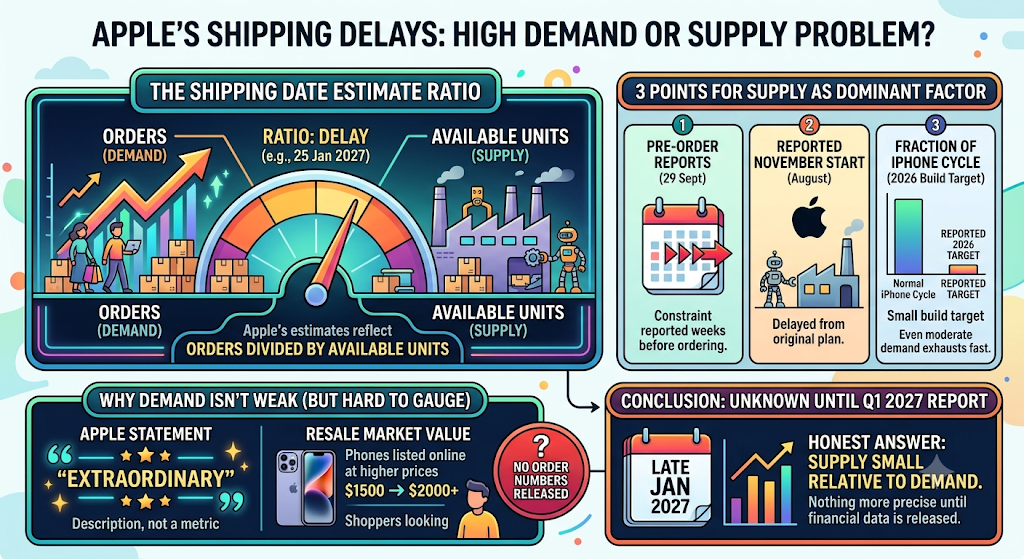
A shipping date is a ratio, not a sales figure. Apple's estimates reflect orders divided by available units, so a slip to 25 January 2027 can mean enormous demand, a very small first batch, or both. Nobody outside Apple knows how much supply existed on day one.
Three points favour supply as the dominant factor. First, the constraint was reported on 29 September, more than two weeks before anyone could order. Second, Gurman's own reporting had Apple considering a November start as recently as August. Third, the reported 2026 build target is a fraction of a normal iPhone cycle, so even moderate demand would exhaust it fast.
That does not mean demand is weak. Apple's statement to the Financial Times used the word "extraordinary," and resale listings well above the list price point to real scarcity value. But Apple has released no order numbers, and "extraordinary" is a description, not a metric. Until Apple reports its fiscal first quarter in late January 2027, the honest answer is that the sell-out proves supply was small relative to demand, and nothing more precise than that.
For customers. Anyone who ordered after the first half-hour is looking at delivery in late January 2027. Walk-in stock looks unlikely: Apple Store employees said they had been advised there would probably be no units for customers without a pre-order on launch day, and were told to discourage such visits. Apple's online store says to check back on 24 October for pickup, but that is not a stock promise. Carriers and resellers remain the only other channels. Apple has a record of beating its own estimates once production ramps, so late-January dates may improve, but none of that is guaranteed.
The secondary market has already priced the scarcity, with pre-orders changing hands well above list price in the first days after the sell-out.
For Apple. The Duo is Apple's entry into a category Samsung has shipped for seven years, and reported assembly yields near 60% show how far its manufacturing is from a mature iPhone. The company appears to have decided an October launch inside its fiscal first quarter was worth more than a cleaner one in November or a staged rollout.
That choice is the heart of the "major mistake" charge. A product that disappears in 30 minutes across 70 countries is a strong signal that the foldable iPhone has an audience at $1,999. The cost is a launch week defined by frustrated early adopters, staff warning people away from stores, and a prominent Bloomberg reporter calling the decision wrong. The commercial risk is sharper than the reputational one: every buyer told to wait three months has time to reconsider, to buy an iPhone 18 Pro instead, or to look at a competitor's foldable.
India is in Apple's first launch wave and sold out as fast as the United States did. Pre-orders opened on Apple's India online store at 5:30 p.m. IST on 16 October 2026, which is the same moment as the 5 a.m. Pacific start, and the allocation was gone within about an hour. Fresh orders now show a delivery date of 23 January 2027. Flipkart's listing showed the phone as out of stock from the start, and Indian buyers could no longer select in-store pickup at major Apple outlets.
In India the iPhone Duo starts at ₹2,99,900 for 256GB and reaches ₹4,49,900 for 2TB. That makes the base Duo about ₹1,35,000 more expensive than the iPhone 18 Pro, which starts at ₹1,64,900. The 16 October pre-order and 23 October launch landed in the middle of India's festive shopping season, and a late-January delivery pushes most Indian purchases past it.
The 23 October wave also covers Australia, Canada, China, France, Germany, Japan, Singapore, the United Kingdom and others. Within 30 minutes of pre-orders opening, estimates had slipped to around 25 January in most of those countries. A second wave of 28 countries and regions follows on 30 October, and it is unclear whether those markets will receive meaningful stock given the January backlog in the first wave.
Apple has made no market-specific statement on supply for India, China or any other country as of 19 October 2026.
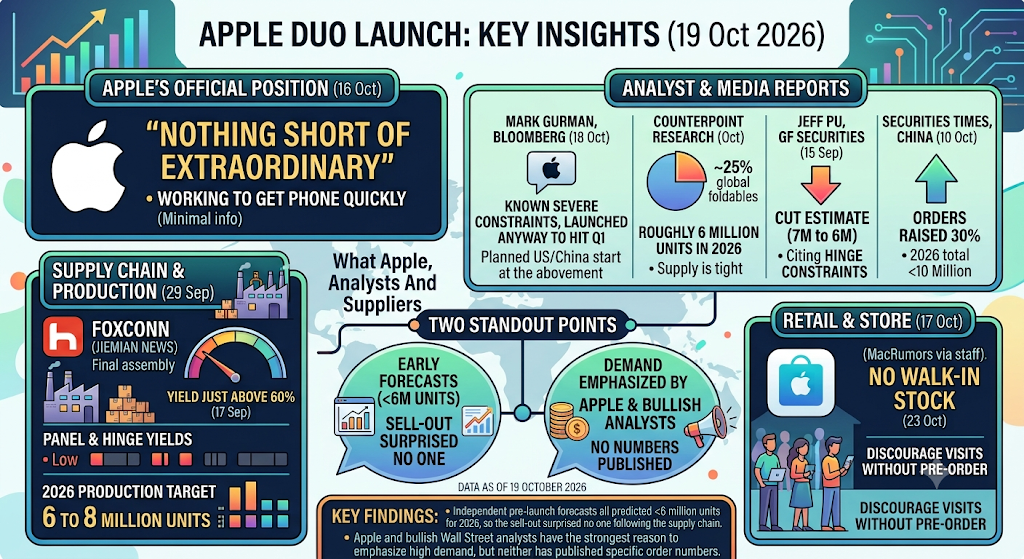
Apple has made one statement, and it does not address supply. Everything else comes from analysts and supply-chain reporting.
| Source | Position | Date |
|---|---|---|
| Apple, to the Financial Times | Demand is "nothing short of extraordinary"; working to get the phone to customers quickly | 16 Oct 2026 |
| Mark Gurman, Bloomberg Power On | Apple knew of severe constraints and launched anyway to hit fiscal Q1; originally planned a United States and China start | 18 Oct 2026 |
| Counterpoint Research | Roughly 6 million Duo units in 2026, about 25% of global foldable shipments; supply is tight | Oct 2026 |
| Jeff Pu, GF Securities | Cut 2026 shipment estimate from 7 million to 6 million, citing "hinge constraints" | 15 Sep 2026 |
| Securities Times, China | Apple raised Duo supply-chain orders by 30%; 2026 total still under 10 million | 10 Oct 2026 |
| Jiemian News, China | Foxconn final-assembly yield just above 60% on 17 Sep; panel and hinge yields low; 2026 target 6 to 8 million | 29 Sep 2026 |
| Apple Store employees, via MacRumors | Told to expect no walk-in stock on 23 Oct and to discourage visits without a pre-order | 17 Oct 2026 |
Two points stand out. Every independent forecast made before launch put 2026 supply at six million units or fewer, so the sell-out surprised nobody who follows the supply chain. And the loudest voices on demand, Apple and bullish Wall Street analysts, are also the ones with the most reason to emphasise it. Neither has published a number.
Foxconn and Samsung Display have made no public comment on the yield reports. No supplier, carrier or retailer has stated allocations as of 19 October 2026.
The next six days will show whether Apple's shipping estimates were conservative or accurate. Apple typically quotes delivery windows it can beat, so customers holding January 2027 dates may see them pulled forward. If first shipments on 23 October are followed by a steady trickle of earlier estimates, the "major mistake" verdict will look like a rough week. If 25 January holds through November, it will look like a structural shortfall.
Key dates to watch:
23 October 2026: first deliveries and launch day. Whether any store has walk-in stock will be the first public test of the retail warning.
24 October 2026: the date Apple's online store told customers to check back for in-store pickup availability.
30 October 2026: launch in 28 additional countries and regions. Allocations here will show whether Apple is spreading supply thinner or prioritising the first wave.
Late January 2027: current delivery estimates fall due (25 January in the US, 23 January in India), and Apple reports its fiscal first quarter, the first hard data on Duo revenue.
The facts that are settled are narrow. Pre-orders opened on 16 October 2026, sold through the 2026 allocation in roughly half an hour across more than 70 countries, and now quote late-January 2027 delivery. The facts that matter most, how many units Apple had and how many it sold, remain unpublished. Gurman charges that Apple chose a global launch inside its holiday quarter over a smaller, smoother one, knowing supply was short. Apple's reply is that demand was extraordinary. Both can be true, and the evidence reviewed here suggests both are. What is not in dispute is that the customers most eager to buy Apple's first foldable are, for now, the ones waiting longest.

If confrontation makes your stomach turn, a man in southern China has a proposition. Pay him ¥188, roughly $26 by the vi...

A 49-year-old bricklayer sold almost everything he owned and spent more than 36 hours on a bus, convinced he was travell...

Elon Musk said on Sunday, October 25, 2026, that SpaceX had closed $40 billion in debt financing to buy graphics process...

Tom Brady and Candice Swanepoel are reportedly dating, according to a wave of entertainment reporting that began on Satu...