StoriesIG in 2026: A Closer Look at Its Features and Safety
The reason most people land on a tool like StoriesIG is one practical question: can I view or save someone’s public Inst...
In its June 2026 list, Forbes reported that its 50 top creators earned a combined $1.02 billion over the prior year, about 20 percent more than the $853 million the year before. By October 2026, the wider creator economy had crossed half a trillion dollars in value. The woman who earned the most on that Forbes list was not a stunt channel. It was Ms. Rachel, who made around $26 million teaching toddlers on YouTube.
“Social media girls” is the casual phrase for the girls and women who build audiences, and often careers, by posting online. In 2026, the serious ones are founders and media operators as much as entertainers. Charli D’Amelio turned a TikTok dance account into a product and media business. Diipa Büller-Khosla turned a fashion following into indē wild, a beauty brand. This article covers who these creators are, where they post, how they actually earn, what changed in 2026, and the pressures that come with the work.
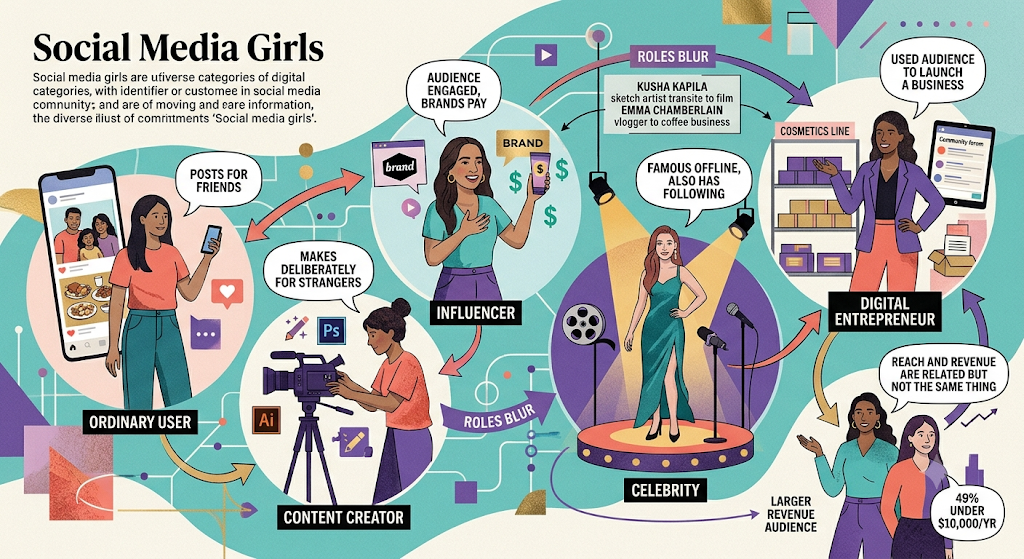
The phrase covers several roles that people often confuse. An ordinary user posts for friends. A content creator makes things deliberately for strangers. An influencer is a creator whose audience is engaged enough that brands pay her to appear in campaigns. A celebrity is someone already famous offline who also has a following. A digital entrepreneur has used her audience to launch a business, like a cosmetics line or a paid community.
These roles blur. Kusha Kapila went from comedy sketches to acting in films. Emma Chamberlain went from vlogging to running Chamberlain Coffee. What ties the group together is a recognisable public identity, a two-way relationship with followers, and a community that forms around the content.
Being popular online does not automatically mean earning money from it. Many women have large followings and no income from them, and in the United States about 49 percent of creators earn under $10,000 a year, so reach and revenue are related but not the same thing.
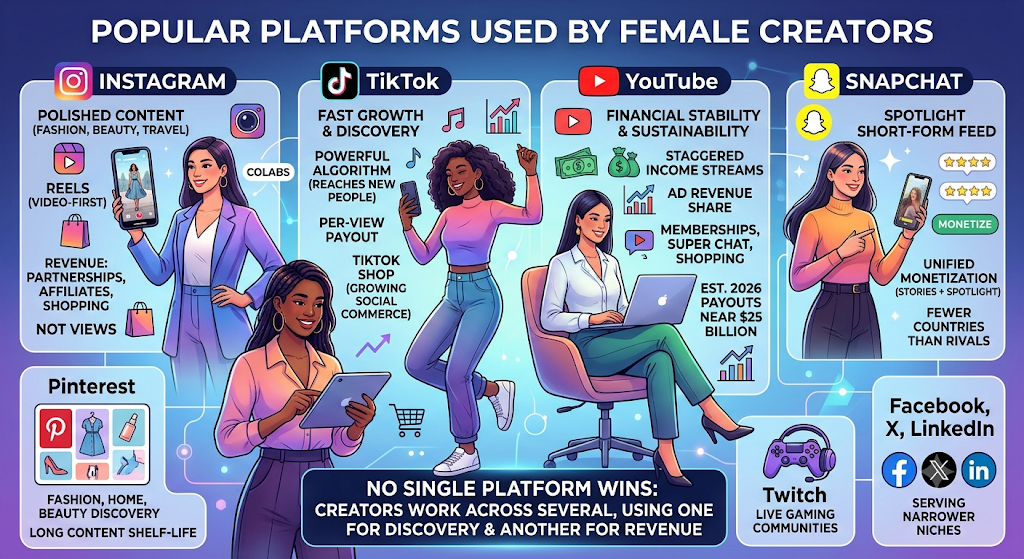
No single platform wins, and most serious creators work across several, using one for discovery and another for revenue.
Instagram is the home of polished fashion, beauty, travel, and lifestyle content, increasingly video-first through Reels. It is unusual in that it pays creators almost nothing for views, focusing instead on partnerships, affiliate links, and shopping features.
TikTok remains the fastest way to reach new people, because its algorithm is still the most powerful at surfacing unknown creators to large audiences. It also has a real per-view payout and a fast-growing shopping layer, with TikTok Shop now commanding roughly 18 percent of United States social commerce.
YouTube is the most financially stable option for creators who can sustain it, because it stacks several income streams at once, including ad revenue share, channel memberships, Super Chat, Super Thanks, and Shopping. Estimated 2026 payouts to creators run near $25 billion on YouTube alone, well ahead of other platforms. It suits longer formats and Shorts alike.
Snapchat rebuilt its creator business around Spotlight, its short-form feed. Since February 2025, eligible creators can earn from both Stories and Spotlight videos under one unified Monetization Program, though in fewer countries than its rivals.
Pinterest drives fashion, home, and beauty discovery with unusually long content shelf-life. Twitch anchors live gaming communities. Facebook, X, and LinkedIn each serve narrower niches.
| Platform | Common content formats | Types of creators who use it | Audience-building opportunities | Relevant monetization options |
|---|---|---|---|---|
| Reels, photo carousels, Stories, lives | Fashion, beauty, lifestyle, travel, food | Reels reach, Explore, hashtags, collabs | Brand deals, affiliates, Shopping, subscriptions, Gifts | |
| TikTok | Short videos, 1 minute+ videos, lives | Comedy, beauty, dance, cooking, daily life | Strong algorithmic discovery for new accounts | Creator Rewards, TikTok Shop affiliate, LIVE gifts, Series, brand deals |
| YouTube | Long-form video, Shorts, lives | Vloggers, educators, beauty tutorials, gaming | Search, recommendations, Shorts, subscriptions | Partner Program ad share (~55%), memberships, Super Chat, Shopping |
| Snapchat | Spotlight clips, Public Stories, AR lenses | Short-form entertainers, younger-skewing creators | Spotlight feed, Discover, AR formats | Spotlight ad-revenue share, Snapchat+ features |
| Pins, idea pins, boards | Fashion, home, DIY, beauty | Search-driven discovery, long shelf-life | Affiliate links, brand partnerships, shopping | |
| Twitch | Live streams, clips | Gamers, just chatting, music, art | Live community, raids, Discord spillover | Subscriptions, Bits, ads, donations, sponsorships |
The right platform depends on a creator’s niche, where her audience lives, her comfort on camera, and whether she wants reach, trust, or revenue.
Looks, styling logic, and transitions. Komal Pandey (@komalpandeyofficial) is known for bold, experimental styling and transition-heavy videos rather than plain outfit photos. Audiences follow for ideas they can copy.
Tutorials, reviews, and product testing, where an honest reviewer moves sales. Mikayla Nogueira built a large following by making techniques feel achievable, and Meredith Duxbury (@meredithduxbury) became known for a signature full-coverage application style.
Personality over a single skill. Alix Earle (@alixearle) defined the 2026 version with candid day-in-my-life content that made her one of Forbes’ top earners.
Sketches, characters, relatable takes. Kusha Kapila (@kushakapila) built a following on urban-India satire, then moved into films and web series. Comedy spreads because people share it.

Workouts, form, and nutrition, with a growing push toward realistic, sustainable content over extremes. Audiences follow for structure and accountability.
Destination films, budget guides, and solo-travel content that mixes aspiration with practical detail. Short clips now drive real tourism to specific spots.
Live play and community. Women in this space built large, highly engaged live audiences on Twitch and YouTube despite long being treated as an afterthought in gaming.
One of the most valuable niches. Ms. Rachel (@msrachelforlittles) built a toddler-education channel into the highest female earner on the 2026 Forbes list. Finance explainers, study creators, and career coaches thrive because the content is genuinely useful.
The endgame for many. Diipa Büller-Khosla turned a following into indē wild, and creator-led coffee, cosmetics, and apparel brands became a defining feature of 2026.
A cross-section across markets and niches. Follower counts are approximate and shift daily. Earnings, where given, are Forbes’ June 2026 estimates for the prior year.
Prajakta Koli (@mostlysane) makes comedy, entertainment, and social-impact content on YouTube and Instagram, and now acts as well. In July 2025 she became the first Indian content creator featured on the TIME100 Creators list.
Kusha Kapila (@kushakapila) posts comedy and satire on Instagram and YouTube, with roughly 4 million Instagram followers, and has moved into film while pairing her content with mental-health advocacy.
Komal Pandey (@komalpandeyofficial) is a fashion and styling creator on Instagram and YouTube, with around 1.9 to 2 million Instagram followers, known for fearless, experimental looks aimed at young women.
Masoom Minawala (@masoomminawala) focuses on luxury fashion on Instagram and YouTube, with roughly 1.3 to 1.4 million Instagram followers, and is notable for walking the sari ramp worldwide and collaborating with heritage fashion houses.
Diipa Büller-Khosla (@diipakhosla) works in fashion and beauty on Instagram, and her standout achievement is building indē wild from an influencer platform into an actual beauty brand with international reach.
Charli D’Amelio (@charlidamelio) built a dance and short-form following on TikTok and Instagram, ranking sixth on the 2026 Forbes list with about $18 million and roughly 209.8 million total followers.
Ms. Rachel (@msrachelforlittles) makes children’s education videos on YouTube and was the highest-earning female creator on the 2026 Forbes list at around $26 million.
Alix Earle (@alixearle) posts lifestyle and get-ready-with-me content plus a podcast on TikTok and Instagram, and placed on the 2026 Forbes list with roughly $12 million.
Nara Smith (@naraaziza) makes cooking and lifestyle videos on TikTok, earned around $7.5 million by Forbes’ estimate, and is known for a calm, made-from-scratch aesthetic that became its own genre.
Meredith Duxbury (@meredithduxbury) makes makeup content on TikTok and was included in Forbes 30 Under 30 and the Top 50 Creators list.
Alex Cooper (@alexandracooper) hosts the Call Her Daddy podcast and was named the highest-earning female creator by Forbes with estimated earnings of $32 million in 2024, a benchmark for audio-first creators.
Growth rarely comes from one post. The factors that reliably matter are a recognisable format people spot instantly, storytelling that gives content a reason to exist, real interaction with followers, consistency that trains both the algorithm and the audience, good timing on culture, and collaborations that borrow another creator’s audience. Platform recommendations can turn an unknown account into a national name overnight, which is how fast-rising TikTok careers accelerate.
Brands have learned that a smaller creator with a trusted, tightly-defined audience often converts better than an account with millions of passive followers. A niche creator whose community acts on her word outperforms a mega-account people scroll past, which is why the industry now talks about a maturing creator middle class of mid-sized specialists building durable businesses.
None of this is a formula. No posting schedule or trending sound guarantees growth. The creators who last found a real audience and kept showing up for it.
Short-form video is still the front door, contributing nearly 52 percent of total creator engagement worldwide, though creators now treat it as discovery and convert attention into revenue elsewhere.
Authenticity keeps beating polish. Raw, personal content outperforms glossy, over-produced posts, which is part of why Nara Smith’s unhurried cooking videos and Alix Earle’s unfiltered vlogs travel so far.
Ownership is the clearest structural shift. The ambition has moved from being an influencer to owning a product line, a paid community, or a media brand, and memberships and subscriptions are now among the fastest-growing revenue channels.
Social commerce is the biggest commercial story. The global social commerce market is worth about $2.11 trillion in 2026, growing near a 29 percent annual rate, and United States social commerce sales reach roughly $101 billion. Live shopping, where creators sell in real time, converts at close to 30 percent against 2 to 3 percent for conventional online shopping.
AI has moved into the workflow. Creators mostly use it to speed up video editing and content repurposing and to analyze audience behavior rather than to replace judgement, and platforms are adding their own tools, including YouTube’s Veo 3 Fast and Edit with AI for Shorts.
Separating settled from speculative, short-form dominance, authenticity, and social commerce are established and well-evidenced. Newer and unproven is TikTok’s announced agentic commerce and AI assistants, aimed at a 2027 expansion, worth watching but not yet showing up in creators’ daily results.
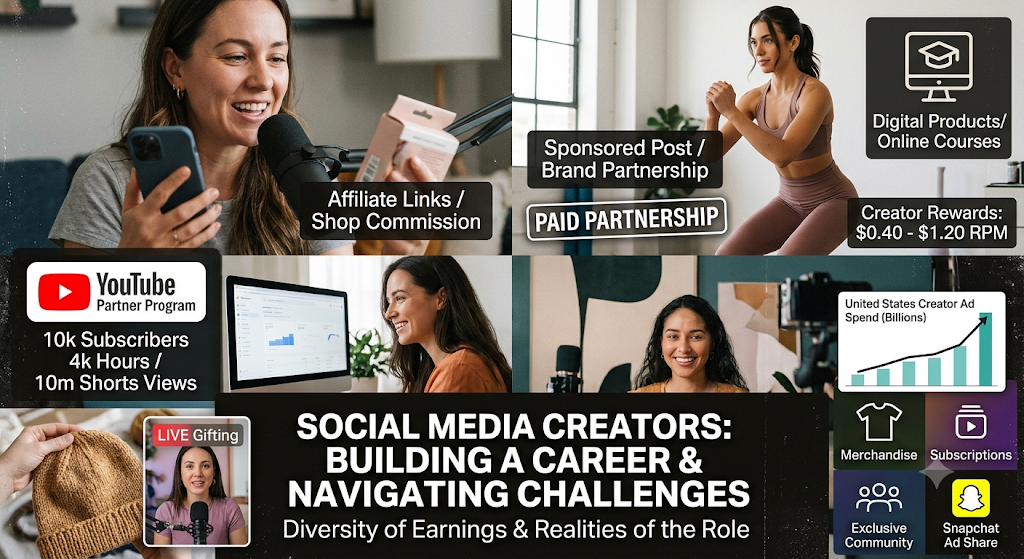
Full-time creators stack several streams, and the mix depends heavily on platform and country. Sponsored content remains the single largest channel, at roughly 59 percent of creator revenue, which is why United States creator ad spend is on track to reach about $44 billion in 2026.
Sponsored posts and brand partnerships are the backbone, especially on Instagram and TikTok, where sponsors usually pay more than platform payouts. Affiliate marketing, earning a commission on sales a creator drives, has become a major early income source, particularly through TikTok Shop.
Platform programmes differ sharply. YouTube shares about 55 percent of ad revenue with creators on long-form videos, and the full Partner Program generally needs 1,000 subscribers plus either 4,000 public watch hours in 12 months or 10 million Shorts views in 90 days. TikTok’s Creator Rewards Program asks for 10,000 followers and 100,000 valid views in the last 30 days on original videos over one minute, paying roughly $0.40 to $1.20 per 1,000 qualified views, on top of LIVE gifts, Shop commissions, and Series subscriptions. Instagram pays little or nothing per view and routes income through brand deals, Gifts, and Subscriptions. Snapchat shares ad revenue through Spotlight for creators with at least 50,000 followers who post frequently. Facebook has even offered guaranteed monthly payments of $1,000 for accounts over 100,000 followers and $3,000 for those over one million to post there.
Beyond platforms, creators earn from subscriptions and paid communities, live-stream gifting, digital products like presets and courses, merchandise, and their own businesses.
Two cautions. Eligibility, payout rates, and tax rules vary by country, so the same follower count earns differently in different markets. And the headline Forbes figures are the exceptional top of a very wide pyramid. In the United States about half of creators earn under $10,000 a year, so celebrity earnings are not a benchmark for a typical creator.
Harassment and unwanted attention are routine, from cruel comments to coordinated pile-ons and sexual harassment that men in the same roles face far less. Privacy risk is constant, since revealing a city, a routine, or a child’s face can have real consequences. Impersonation and fake accounts are common, and AI has made this worse, with manipulated images and non-consensual explicit deepfakes now a serious and growing threat.
Unauthorised use of photographs rests on a point many audiences miss. Posting something publicly is not the same as consenting to it being copied, edited, sold, or reused elsewhere. Visibility does not transfer ownership or permission.
There is also pressure to maintain an idealised appearance, worsened by filters, plus income instability as earnings swing with brand budgets, and dependence on algorithms, where one ranking change can erase reach built over years.
For audiences, a steady feed of filtered, idealised beauty content is linked in credible research to body-image pressure and comparison, especially among young viewers. Not every woman online experiences these harms equally, since context and niche vary, but the risks are real, and much of the responsibility to fix them sits with platforms rather than individual creators.
The influence is measurable. Around 65 percent of consumers have bought a creator-founded product or service, a figure that rises to 91 percent among 16 to 24-year-olds, and 58 percent of adults have bought something because of an influencer endorsement. The “TikTok made me buy it” effect is now a real retail force, with health, beauty, and apparel the categories creators move most. They set fashion and beauty trends that reach the high street, coin and spread slang, drive entertainment discovery, and increasingly lead conversations about body image and confidence.
The effects are not all positive, and honest coverage holds both sides. On the upside, creators widened representation and made expert knowledge accessible, and a healthy counter-trend emerged from inside the community called de-influencing, where creators tell audiences what not to buy.
The criticisms are equally real. Recommendations are often paid and not always disclosed clearly, which erodes trust. Haul and shopping culture can fuel over-consumption. Aspirational beauty content can reinforce narrow standards. The sensible position in 2026 is neither to dismiss creator influence nor to trust every viral recommendation, but to assume commercial interest until shown otherwise.
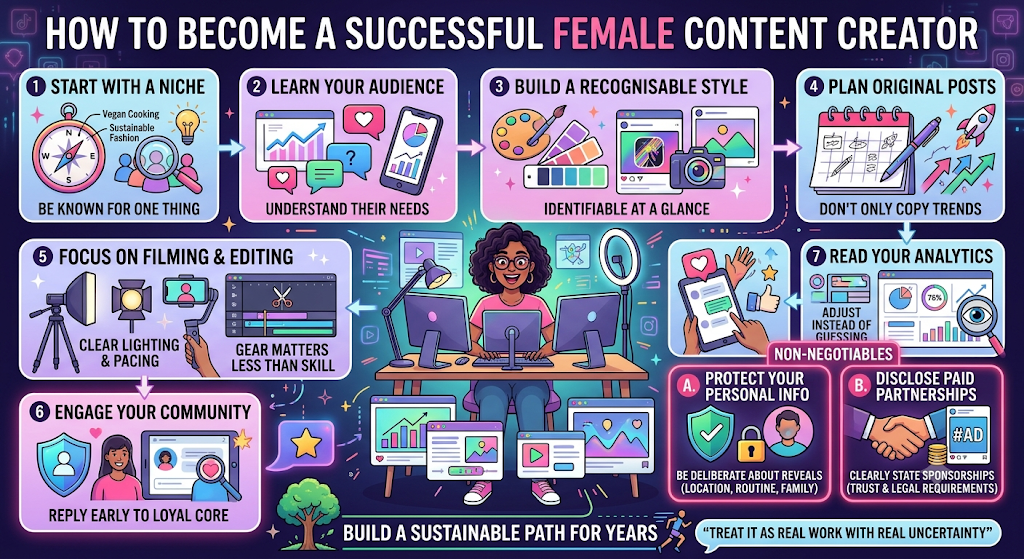
Start with a niche specific enough to be known for one thing, then learn what that audience actually wants. Build a recognisable style so your content is identifiable at a glance, and plan original posts rather than only copying trends. Filming and editing matter more than expensive gear, so focus on clear lighting and pacing. Write captions that add something, and reply to comments early, since that loyal core is what the algorithm rewards. Read your analytics and adjust instead of guessing.
Two things are non-negotiable. Protect your personal information by being deliberate about what you reveal, including location, routine, and family. Disclose paid partnerships clearly, both because trust depends on it and because most countries require it by law.
Build something you can sustain for years rather than chasing every trend. And honestly, no one can promise quick fame, a guaranteed follower count, or a set income. The creators who succeed treat it as real work with real uncertainty.
The most striking thing about female creator culture in 2026 is not the money, though the numbers now rival traditional entertainment. It is that the market started rewarding the right things. The highest-earning woman on the Forbes list built her audience teaching toddlers to talk. The fastest-growing businesses belong to creators who turned trust into products and paid communities. The clearest counter-movements, from de-influencing to realistic fitness, came from creators pushing back against the industry’s worst habits.
Reach alone is no longer the whole story. Originality, a real relationship with an audience, and basic responsibility, meaning disclosing ads, protecting privacy, and not selling things you do not believe in, are what separate creators who last from accounts that spike and vanish. The pressures are real too, and they fall hardest on women, from harassment to deepfakes to the gap between public visibility and genuine consent.
For readers, the takeaway is not cynicism or starry-eyed trust. It is the same judgement you would use anywhere, enjoying the creativity, learning from the useful, and remembering that a recommendation can be heartfelt and paid for at the same time. Female creators have earned a permanent place in culture. The next phase is less about who can go viral and more about who can be trusted.

The reason most people land on a tool like StoriesIG is one practical question: can I view or save someone’s public Inst...
AnonyIG is a free, browser-based tool that claims to let you view public Instagram Stories, Highlights, Reels, and posts...
IntroductionPeople search “Insta PV,” sometimes written InstaPV, because they want to see someone’s public Instagram sto...
People come to InSnoop to do one thing that is to watch a public Instagram Story without opening it from their own accou...