
Best AI Headshot Generators for Profile Photos
A profile photo is often the first impression you make on a recruiter, a client, or a new connection. AI headshot genera...
People use “AI-generated” and “auto-generated” as if they are the same thing, and in casual talk nobody minds. The trouble starts when the labels carry weight. A client asks whether your pages are “just auto-generated,” a search policy turns on how content was made, or a teammate assumes “AI wrote it” means no human touched it. At that point loose wording leads to the wrong call.
The two words describe different things. AI-generated points to the method that produced the words or images, which is a generative model. Auto-generated points to the process that delivered them, which is an automated workflow that runs without a person doing each step by hand. One is about what created the content. The other is about how it reached the page. Because those are separate questions, the answers can be yes to both, yes to one, or yes to neither.
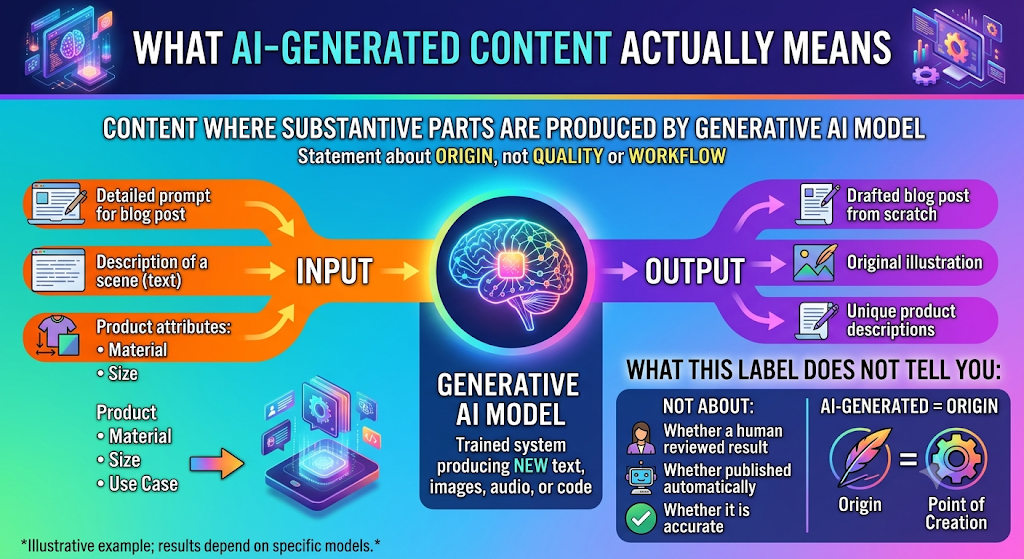
AI-generated content is content whose substantive parts were produced by a generative AI model. The defining feature is the technology, a system trained to produce new text, images, audio, or code in response to an input, rather than pulling fixed text from a database or stitching together a template.
A few concrete cases make this clear. You give an AI writing tool a detailed prompt and it drafts a blog post from scratch. You describe a scene in words and a generative image tool produces an original illustration. You feed an AI system a set of product attributes such as material, size, and use case, and it writes a unique description for each item.
Notice what this label does not tell you. It says nothing about whether a human reviewed the result, whether it was published automatically, or whether it is accurate. AI-generated is a statement about origin, not about quality or workflow. A writer can generate a draft with AI and then spend an hour fact-checking and rewriting it, and the draft was still AI-generated at the point of creation.
Auto-generated content, more precisely “automatically generated content,” is content produced or published through an automated process, with little or no manual work for each individual output. The defining feature is the process, not any particular technology.
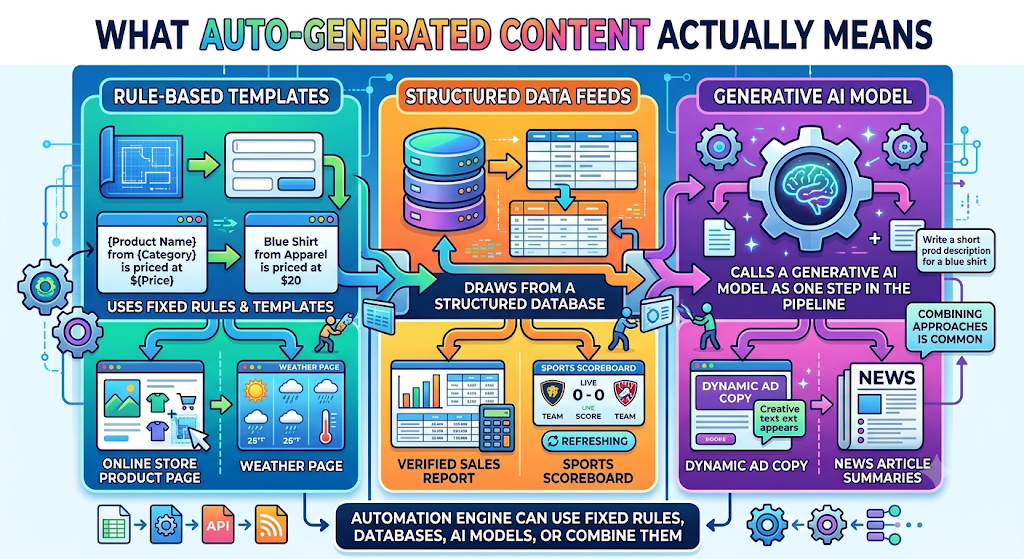
Automation can run on several different engines. It might use fixed rules and templates that slot values into a predefined layout. It might draw on a structured database that supplies the raw facts. It might call a generative AI model as one step in the pipeline. It might combine these.
Plenty of automated content involves no AI at all. An online store builds a product page for every item by pulling fields from its catalogue into a template. A reporting system turns verified sales figures into a standard daily report using a fixed format. A publishing workflow creates or updates pages automatically whenever records in a database change. A weather page assembled from a feed, a sports scoreboard that refreshes itself, a directory built from a spreadsheet. All automated, all built on rules and data rather than a model.
The cleanest way to hold the distinction is this. AI-generated answers what made the content. Auto-generated answers how the content was produced and delivered. Because those are different axes, four combinations exist.
The practical takeaway is that auto-generated does not have to mean AI-generated, and AI-generated does not have to mean fully automated. When someone says content is auto-generated, the useful follow-up is “generated how, by what.” When someone says it is AI-generated, the useful follow-up is “was it reviewed, and was it published automatically.”
The table contrasts the two along the dimensions that matter in real work. Treat the variation and advantages rows as tendencies rather than laws, because the actual behavior depends on the system, its settings, the input data, and how the workflow is built.
| Dimension | AI-generated | Auto-generated |
|---|---|---|
| Basic meaning | Content created by a generative AI model | Content produced or published through an automated process |
| What the label describes | The method of creation | The process of production and delivery |
| Technology involved | A generative model for text, image, audio, or code | Rules, templates, databases, or a model, or a mix |
| Role of human input | Human writes the prompt and may or may not review the output | Human builds the system and data and usually does not touch each output |
| How outputs are produced | The model generates new output from an input | The workflow assembles or triggers output from data, rules, or a model call |
| Variation between outputs | Can vary widely with prompts and settings | Often uniform with templates, varies when a model or changing data is involved |
| Real examples | Draft from a prompt, generated illustration, model-written descriptions | Templated product pages, scheduled posts, database-driven reports |
| Typical advantages | Flexible phrasing, adapts tone, creates genuinely new text or imagery | Predictable formatting, repeatable, fast, handles structured data at scale |
| Common risks | Factual errors, unsupported claims, inconsistent tone | Rigid output, bad source data, duplicate pages, breaks when data is incomplete |
| How quality is checked | Human fact-checking and editing before use | Validating source data, templates, and output, plus spot checks and monitoring |
| Can they overlap | Yes, whenever a model is the generation step inside an automated workflow | Yes, the same case, so the output is both AI-generated and automated |
Work through these the way you would handle an unfamiliar case. Name what creates the content, whether AI is involved, whether the process is automated, which label fits, and what a human should check.
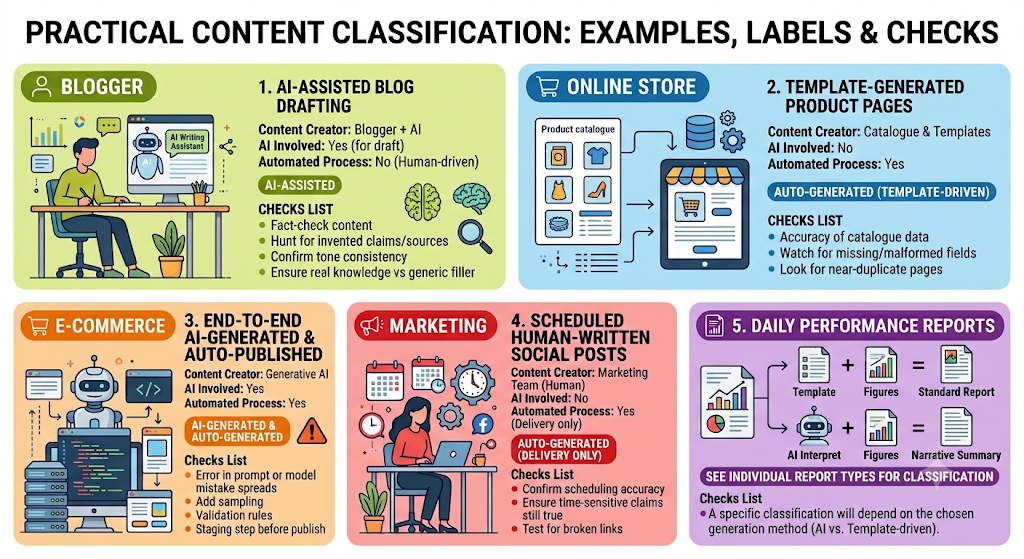
A blogger drafts an article with an AI writing assistant, then rewrites and corrects it before publishing. AI is involved and the content is AI-generated at the draft stage, but the process is not automated because the person drives each step and publishes by hand. Once the writer has substantially shaped it, “AI-assisted” describes it fairly. Before publishing, that person should check facts, hunt for invented claims or sources, confirm tone consistency, and make sure the piece reflects real knowledge rather than generic filler.
An online store builds product pages from a structured catalogue using fixed templates. No model is involved, so this is auto-generated, specifically template-generated. The process is automated. The team should check the accuracy of the catalogue data, watch for missing or malformed fields, and look for near-duplicate pages across similar products that add little unique value.
An e-commerce business uses generative AI to draft descriptions and sends them straight into publishing. AI is involved and the process is automated, so the output is both AI-generated and auto-generated, end to end. This is the highest-risk pattern, because an error in the prompt or a model mistake can spread across hundreds of live pages before anyone notices. The business should add sampling, validation rules, and a staging step before publish.
A marketing team schedules prewritten social posts through an automation tool. The copy is human-written, so no AI is involved in the content. Only the delivery is automated. The team should confirm scheduling accuracy, make sure time-sensitive claims are still true at post time, and test for broken links.
A business produces a daily performance report from database figures, and the term depends on the method. If a template turns verified figures into a standard report, it is auto-generated and template-driven with no AI. If the business instead uses AI to interpret the figures and write a narrative summary, that summary is AI-generated, and if it runs on a schedule it is also automated. In both versions the underlying figures must be correct, since a template faithfully reproduces whatever it is given, and in the AI version the narrative must not misread the data or overstate a trend.
The pattern across all five is the same. Identify the generation engine and the delivery process separately, then apply whichever labels fit.
Several neighboring terms describe different degrees of human and machine involvement, and they are not synonyms. AI-generated content means a model produced the substantive output. Automatically generated content means an automated process produced or delivered it, by whatever engine. AI-assisted content means a person did the core work and used AI as a tool for parts of it, such as an outline, a rephrase, or a first draft they then reworked heavily, so the human is the author in a meaningful sense. Human-written content means a person wrote it, and light help from a spell-checker does not change that. Template-generated content is produced by filling a fixed structure with data, with no model and no original composition. AI-assisted automation keeps a human in the loop to approve outputs, while end-to-end automated publishing creates and publishes with no human reviewing each item.
One caution is worth stating plainly. Editing an AI draft does not automatically make the piece human-written. If a model produced the structure and most of the sentences and a person tidied it, “AI-assisted” is more honest than “human-written.” These labels sit on a spectrum of involvement, and where a given piece lands is a judgment call.
You rarely need a tool for this. You need to answer a few questions, and you may answer yes to more than one. The goal is to describe how the content was made, not to force it into a single exclusive box.
First, did a generative AI model create substantive parts of the output. If yes, it is AI-generated at least in part. Second, was the output created or delivered through an automated workflow. If yes, it is auto-generated. Third, did a human substantially write, review, or edit it. If yes, “AI-assisted” or “human-written” may describe it better than “AI-generated” alone. Fourth, was it produced using fixed rules, a template, or structured data instead of a model. If yes, it is template-generated automation rather than AI generation.
Multiple yeses are normal. A description written by a model inside a scheduled pipeline and then spot-checked by an editor is AI-generated, automated, and partly human-reviewed all at once, and that full description is more accurate than any single label.
After sorting through a lot of these cases, here is where I land. The question people reach for first, whether a machine was involved, turns out to be the least useful one, because a machine is involved in almost everything now. The questions that actually predict whether content is any good are different. How was it created, how much control did people keep over it, and is the final result accurate and genuinely useful to the person reading it.
On that basis I think generative AI earns its place when you need original phrasing, flexible tone, or imagery that did not exist before, and when a human stays close enough to catch its mistakes. Rule-based automation earns its place when the information is structured and repetitive and you want it rendered the same clean way every time. The combination of the two is often the smartest option, as long as you remember that it stacks the risks of both and needs validation to match.
What I keep coming back to is that automation is very good at removing repetitive work and very bad at supplying judgment. It reproduces whatever you give it, errors included, and at a scale that turns a small mistake into a site-wide one. So my honest advice is to be precise about these labels, because the label tells you where the human has to stay in the loop. Decide that deliberately rather than by default, keep the source information reliable, and apply real editorial judgment where it counts. The tool is not the thing that makes content worth publishing. You are.

A profile photo is often the first impression you make on a recruiter, a client, or a new connection. AI headshot genera...

Every call that rings out to voicemail is a customer who will probably try a competitor before you call back. That is th...
You have a spreadsheet with hundreds or thousands of rows, and the answer you need is buried in it. Which product is pul...

My inbox this morning was 213 unread. Two are clients who need an answer today. One is a contract waiting on a yes or no...